
The B2B buyer's journey has 3 stages: awareness (educational content), consideration (case studies, webinars), and decision (demos, pricing, testimonials). B2B buyers spend only 17% of their buying cycle meeting vendors, with 6-10 decision-makers involved per purchase. Optimize with intent data, content routing, contact tracking, data segmentation, and CDP tools.
Last Refreshed: March 2026 with updated statistics and tool information.
The B2B buyer’s journey is the three-stage research process — awareness, consideration, and decision — that a buying group of 6-10 decision-makers follows before purchasing a solution, with buyers spending only 17% of their total buying cycle meeting with vendors. The journey has drastically changed over the last few years. The massive amount of information available for present-day decision-makers has produced a more independent research process, meaning that marketing and sales reps have fewer opportunities to connect with prospects.
From Thomas Cornelius, Founder & CEO, graph8: “B2B buyers have already done 70% of their research before they talk to a vendor. Your job isn’t to interrupt that process — it’s to be the content they find while they’re doing it, then show up at exactly the right moment with a reason to act.” According to a Gartner report, B2B buyers spend only 17% of their buyer’s cycle meeting with solution providers. Gartner also predicts that by 2025, 80% of B2B sales interactions will go exclusively through digital channels, as millennials prefer a seller-free sales experience.
Then again, the “vendor-free” part is just a mirage. Inbound marketing strategies aim to convince prospects that they are making the right choices. Once potential buyers have a clear understanding of what they are looking for, outbound actions come forward to provide them with additional tools that confirm those decisions.
In other words, the current state of the B2B buyer’s journey funnel allows prospects to roam freely while companies leave a tray of treats for them to follow. Selling is still there, but pressure over possible buyers is looser. Let’s take a closer look at the buyer’s journey concept and how your brand can leverage it to close more deals.
What Is a Buyer’s Journey?
The buyer’s journey can be defined as the active research process a potential buyer goes through every time an identified need demands the purchase of a solution. By understanding how this experience can be manipulated, B2B marketers and sales professionals are able to position their products as a solid option for the prospect.
Prospect Effectively With CIENCE
The standard B2B buying process follows a set of actions that result in a purchase:
- Problem identification: How can the company address a particular situation?
- Solution analysis: What product could solve the problem?
- Requirements setup: What characteristics need to be bound to the solution?
- Supplier selection: What companies offer the solution we require?
- Validation process: How do these solution proposals solve our needs?
- Consensus decision: Who would be the final decision-makers?
However, before laying asphalt for the B2B buyer’s journey road, marketing and sales teams must agree on what kind of prospect is best suited to walk that path.
Creating ideal customer profiles (ICPs) and buyer personas is fundamental to every lead generation campaign. Still, another layer of prospect development needs to be considered first: finding who is really in charge of the B2B decision-making process.
Groups Involved in the B2B Buyer’s Journey
According to Forbes, the typical enterprise buying group consists of six to ten decision-makers, each provided with at least four pieces of information that would confirm why their chosen solution is adequate.
That said, a frequent cause of failure behind many B2B prospecting plans is the misconception that advertisers and vendors should aim for C-level executives to accelerate their conversion rate. They control the budget that will pay for the chosen solution, right? Yes, but not quite.
A number of people have a certain degree of influence on the buying process. Each of these individuals can perform one or more of the following buying jobs:
Users
The individual contributors will be in charge of deploying the product to solve the identified need. Their insights are most important for their managers who will communicate their satisfaction (or lack thereof) to the upper levels.
Initiators
Team managers or directors usually notice a situation that needs to be solved or foresee an opportunity to improve results by acquiring a specific tool. They will be the ones that delimit the requirements of the product.
Gatekeepers
These are the people that control the incoming information. They can either be assistants of high-end executives or VPs responsible for filtering all significant pieces of data regarding an important decision.
Decision-influencers
A junior- or mid-level manager plays a more significant role in the buying process. The decision-influencer is responsible for the initial research on a product or service and will most likely be part of the user crew. The decision-influencers are the ones who present the data that shapes the decision-makers final call.
Decision-makers
These C-level stakeholders have the final say in signing deals, but they are not often involved in the early research stages of the buyer’s journey. Their contact channels tend to be saturated, agendas overscheduled, and are usually influenced by internal advisers rather than external ones.
While buying jobs may work as a guide to defining a specific individual’s position, roles can shift from one moment to another. Even the people performing them could swap their focus or drop out of the process altogether, forcing the cycle to start again.
All roles are vital for the B2B buyer’s journey, but the timing to reach each one of them, the messages that could trigger their interest, and their consumption of certain types of content differ significantly. This is why leveraging all buyer’s journey stages is vital to generating more high-quality leads.
What Are the B2B Buyer’s Journey Stages?
One of the trickiest elements of B2B buying processes is that they are not linear. Prospects jump back and forward in the different stages, validating their first impressions and comparing several alternatives before moving on to the purchase moment.
That said, learning how to approach each buyer’s journey stage helps to map down the multiple moments of interaction with the prospect, allowing sales and marketing teams to prepare their resources and action plans for the upcoming contact touch.
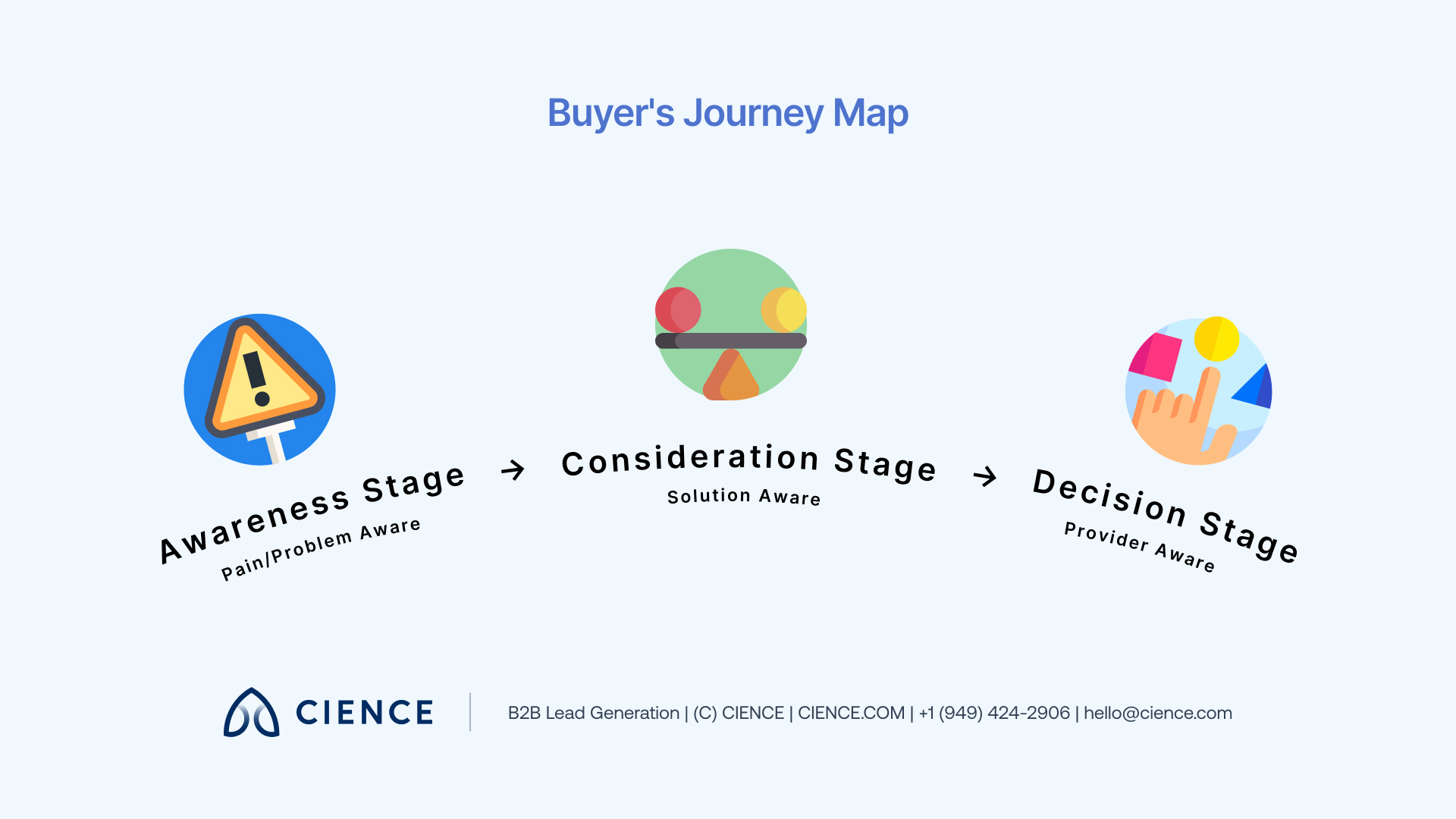
These are the most common B2B buyer’s journey stages and the recommended types of content for each:
1. Awareness
When a potential client recognizes they have a problem that needs to be solved, the buyer’s journey’s first stage begins. This finding may occur by analyzing their internal results, or they could also run across some external content that alerts them to a specific issue.
In this phase, it is critical to demonstrate that your company understands the prospect’s needs and pain points so you can emphasize how your company can assist in addressing those demands. The best content pieces to do so are:
- Educational blog posts
- Whitepapers, checklists, e-books, or guides
- Infographics inside social media
- Accurate industry reports
- Explainer videos
By sharing knowledge about the topics derived from the problem or need, brands can grow closer to the prospects that are actively searching for education.
For example, if a possible buyer is looking for new ways to improve his ads, a video explaining how a demand-side platform (DSP) works could bring some guidance to his research.
2. Consideration
In the consideration stage, prospects have already framed and given a proper name to their need. Many create files with links, e-books, and other educational resources that help them understand the situation. Now they will want to learn more about the different potential solutions in their grasp.
Prospects are getting ready to craft a list of all the brands and products that may offer a solution with the required characteristics. For a company to attract a potential client, it will need to prove that its approaches and methods have effectively solved a similar need in the past.
The following content examples can accomplish this mission:
- Product feature videos
- Live or recorded webinars
- Case studies
- Technical articles
3. Decision
In the final stage of the buyer’s journey, prospects know how to solve their needs and what products or providers seem fit to do so. Here, all the focus swirls around comparing and testing the gathered providers on their list so they can finally decide which one will get the chance to prove their worth.
Therefore, marketers and vendors representing a brand should be ready to show their unique value proposition and all the traits that make their product stand out. It is also the time to understand the most common incoming objections and how to handle each one of them with well-crafted sales messaging.
The most helpful content pieces for this stage are:
- Free product trials or LIVE demos
- Pricing comparison documents
- Documented success stories
- Testimonials
“CIENCE helped us increase monthly appointments by over 500% — far beyond what our internal team had been able to achieve. The data-driven approach made all the difference.” — Silicon Valley Insight
If your outbound is producing diminishing returns despite more tools and more reps, the problem isn’t execution — it’s architecture.
The Importance of the B2B Buyer’s Journey
Conventional sales and marketing techniques often try to close the deal from the earliest stages of the customer’s buyer’s journey. However, nurturing and helping the prospects through demand generation until they feel ready to leap is vital for a long-lasting relationship when they decide to become clients.
Almost every buyer’s journey example will focus on providing organized information to potential buyers so all doubts and concerns about their decision-making process get an answer. Here are a few reasons why businesses benefit from following the buyer’s journey step-by-step:
Promotes inbound marketing
The messages, content, and general efforts derived from the B2B buyer’s cycle are all about solving a specific need. Sharing advice on facing certain situations, highlighting how your product relieves a bullet list of pain points, and becoming an authority on a subject boosts your SEO outreach.
Strengthens tailor-made campaigns
Personalized reach is almost mandatory for the current B2B development tactics. Prospects expect that the proposals coming their way are designed to suit their particular needs. Growing a deep connection with each possible buyer at all the different stages of the journey allows both parties to feel like partners even before signing a contract.
Connect With Our Prospecting Experts
Ensures satisfaction levels
When the purchase is finally made, the provider and the clients already know how to integrate the solution to get fast results. An amicable resolution for both parties is almost guaranteed.
5 Tips to Optimize the B2B Buyer’s Journey
High-quality data has become a powerful asset for tracking your potential customers’ cycle. It allows marketers and sales reps to identify the stage where the prospect is currently standing and notifies them every time the consumed content, clicks on CTAs, attendance to webinars, or other responses suggest that the prospect is ready to make a buying decision.
That said, optimizing the journey so possible buyers spend less time in the early stages and more time speaking to sales experts requires a constant effort. CIENCE has helped 2,500+ B2B clients across 250+ industries do exactly that. The following tips can help sales development representatives (SDRs) and advertisers improve their engagement campaign’s return on investment (ROI):
1. Identify the prospect’s intent.
From Daniel Conn, GTM Strategist, graph8: “Intent data is only as good as your ability to act on it within 48 hours. We see companies collecting the right signals and then sitting on them for weeks. By then, the buyer has already chosen someone else.”
Intent data strategies have opened a new door into the contact channels, even for the less accessible prospects. Collecting behavioral information about the digital users’ web content consumption makes it possible to access meaningful insights about what the prospect is searching for, both on your website and on your competitors’.
2. Establish a coherent content route.
Understanding what content pieces belong to each buyer’s journey funnel will allow marketers and sales reps to define the best triggers for prospects to pull. A well-structured content ladder can guide the prospect from one step to the next subtly and logically.
3. Track every contact touch.
Data exhaust can be understood as the result of every single online action deployed by a user. When processed correctly, it can lead to findings on how prospects educated themselves about their needs, what providers were considered, and what factors were crucial for the purchase.
4. Segment your data.
Data segmentation refers to the dissection of account-related data through different criteria. Regarding B2B buyer journey statistics, it is essential to group all the prospects inside each stage. By defining the characteristics they share (and the ones that make them different), it is easier to point out what targets are being pulled into your pipeline and which have the best probability of closure.
5. Use the right tools.
Organizing, processing, and capitalizing on all the relevant data derived from the buyers’ journey marketing methodology can be challenging without proper assistance. A customer data platform (CDP) is an interactive database that collects relevant information from websites, apps, digital assistants, and marketing clouds.
CIENCE’s B2B data platform offers over 300 million lead records across all industries. Real SDRs validate the quality, freshness, and accuracy of the databases daily and provide insights on how to address each prospect depending on the buyer’s cycle stage. Rated 4.6/5 on Capterra, it’s one of the most trusted sales intelligence tools in B2B.
Master the B2B Buyer’s Journey to Close More Deals
Sales and marketing teams must operate in parallel to extract all the lead generation juice inside the B2B buyer’s journey. While many vendors desire to get to the outbound part of the process as quickly as possible, respecting the inbound-based stages will fill their pipelines with eager-to-purchase prospects.
However, when marketers and sales experts combine their knowledge of the most significant moments of truth and how these were used to create positive, customer-centered responses, it is possible to set the pace of the whole cycle.
Rushing or delaying the prospect too much may result in a lost deal. Every action must be executed at the right time, through the precise channel, and to the ideal target to achieve victory.
“CIENCE generated 4,000+ qualified leads for us in just four months — completely transformed how we approach pipeline.” — August Ash
CIENCE + graph8 pricing: $5,000 one-time GTM system setup, $2,499/mo strategic execution, and the graph8 platform at $499/mo. No long-term contracts. See full pricing →
Whether or not you decide to work with us, you’ll walk away with a clear picture of where your pipeline is leaking and what it would take to fix it.
Frequently Asked Questions
What are the 3 stages of the B2B buyer’s journey?
The 3 stages are awareness (the buyer recognizes a problem and researches it), consideration (the buyer evaluates potential solutions and compares providers), and decision (the buyer selects a vendor and negotiates terms). Each stage requires different content — educational blog posts and guides for awareness, case studies and webinars for consideration, and free trials, demos, and pricing for decision.
How many decision-makers are involved in a B2B purchase?
According to Forbes, the typical enterprise buying group consists of 6 to 10 decision-makers, each armed with at least 4 pieces of information supporting their preferred solution. This includes users, initiators, gatekeepers, decision-influencers, and final decision-makers. Effective B2B marketing must address the needs and concerns of all these roles, not just C-level executives.
How can I shorten the B2B buyer’s journey?
Use intent data to identify where prospects are in their journey and deliver the right content at the right time. Establish a clear content route that guides buyers from awareness through decision. Track every contact touchpoint, segment your data to personalize outreach, and use a customer data platform (CDP) to organize and act on insights. Companies that optimize each stage can accelerate pipeline velocity significantly.

A graph8 company — AI-powered GTM execution across 250+ B2B industries.
graph8 Platform
From $499/mo
Run your own GTM campaigns with AI-powered data, sequences, and analytics.
Start Free — 2,500 Credits No credit card requiredCIENCE Managed
From $2,499/mo
Our GTM teams build and run your outbound campaigns end-to-end.
15-min call · No commitment2,500+ B2B companies served · Month-to-month contracts · See full pricing →