
Sales Discovery Call Questions: Best Practices for 2024

Last Refreshed: March 2026 with updated statistics and tool information.
Sales discovery calls are an integral part of most sales processes. They’re used to qualify leads, assess the viability of certain deals, and establish exactly what a prospect wants and needs. But this can only be achieved by asking the right questions.
Knowing what those questions should be can be a challenge for B2B sales teams. That’s why we’ve crafted this guide covering some of the best questions and practices for sales discovery calls in 2024. Find out what questions to ask and how to do it with these best tips for discovery calls.
What Is a Sales Discovery Call?
A sales discovery call is the first call with a prospect after they’ve indicated their interest, either following an outbound email or through a form on an inbound channel. The call is the first real opportunity for the sales team to gain a clearer insight into the challenges a company is facing and what they want from a solution.
They do this by running through a series of specific questions, the answers to which will help determine whether your product or service is suitable or not. By the end of a sales discovery call, you should be able to decide whether or not the prospect is going to be worth selling to, and if not, you’ll need to disqualify them.

How to Choose the Best Questions for Sales Discovery Calls
The best way to establish a set of sales discovery call questions is to consider what you actually want from a sales discovery call. One of the biggest goals is to determine whether to either qualify or disqualify the lead from the rest of the sales process.
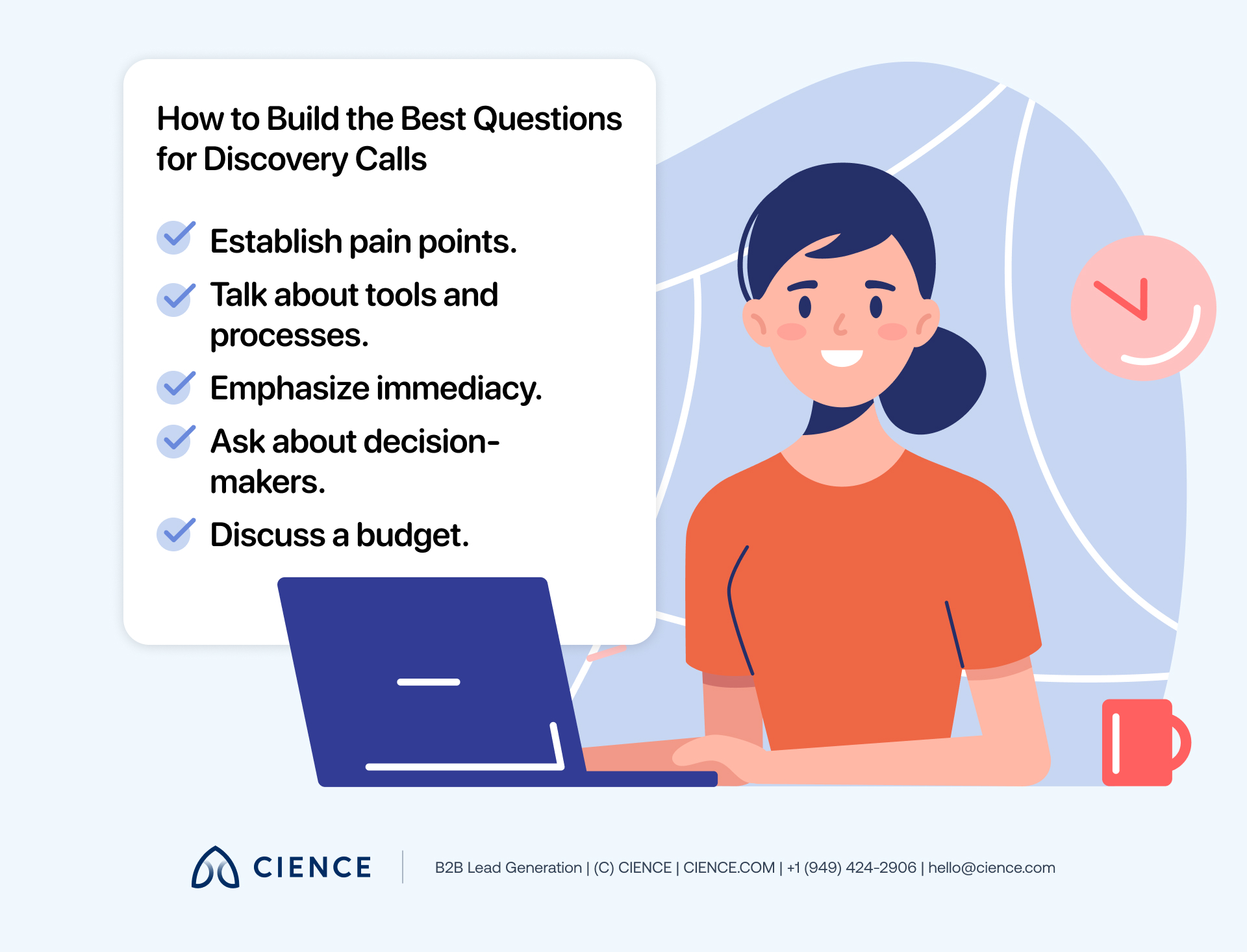
To do this you’ll want to identify the problem they’re trying to solve, their existing processes, how soon they want to implement a solution, who is in charge of doing so, and how much they’re willing to pay. The following tips enable you to do just that:
1. Establish pain points.
Engage your prospects by first identifying their pain points and where you can offer a solution.
Q: What problem are you trying to solve?
This question is clear and direct. It gives you an opportunity to get to the crux about what’s making their existing process inefficient and where your solution can add the most value. By asking the prospect to highlight the key problem areas with their existing workflow, you can confirm where their pain points and friction lie. This information can then be used to assess whether their priorities align closely enough with your value areas or not, and if so, which ones.
Q: What impact is this problem having on your business?
You’ll also want to try and quantify the pain being experienced by the prospect. This is best done in numbers. For example, does the inefficient workflow mean that they miss out on opportunities, or fail to capture revenue efficiently? Can they give a figure to quantify how many hours are currently wasted getting bogged down in administrative processes?
By asking the lead how the problem’s impacting them, you can understand how serious they are about implementing a solution like yours. If the impact is trivial, it’s likely they’ve gotten a lower intent to buy and a lower willingness to pay. Conversely, if lacking the solution means they’re losing revenue, time, or security on a concerning scale, they’ll likely be more committed to finding a solution (and paying for one).
Q: What happens if you don’t do anything about it?
This question carries value in two ways. First, it enables you to understand the true scale of the problem on the prospect’s business. But it also serves as a reminder to the prospect that it’s within their interests to seek this solution, particularly if the pain they’re experiencing will scale with them in the future.
For instance, will not finding a solution halt the company’s growth? Will they need to hire more members into the team if they’re unable to automate certain admin tasks? How much will this cost the business in months and years to come? How serious are these blockers now, and how will they worsen in the future?
Some of the most effective follow-up questions here include: “How much money do you think you’d save if X was no longer a problem?” and “How many opportunities do you think you’ve lost, or will lose, due to X?”
2. Talk about their current tools and processes.
Learn about their current sales processes and how you can offer support to improve their existing workflows.
Q: What does your current process look like?
Next, you want to dig deep into how they currently run things. What processes do they currently rely on and what do their existing workflows look like? This can be a broad question, but you’ll often find that the answers you receive are very similar.
For example, as a company seeking to automate and streamline contract lifecycle management processes, prospects can talk about how they create contracts in a platform like Word and move back and forth between different platforms to get these agreements negotiated and signed. The process typically involves a lot of interaction across departments but also a lot of waiting around for approvals from certain team members.
By describing their existing processes in this way, you can quickly identify how your software and data solutions can simplify their processes and how smooth of a transition it would be from their current process to an improved one.
Q: What tools are you currently using in your workflow?
If they haven’t already answered this in the last question, you’ll also want to ask the prospect which tools they currently use.
Asking a lead what CRM tools they currently use can be an effective way to establish exactly what’s left them dissatisfied with a competitor’s product. Perhaps there are feature gaps that you can fill, for example. This intel can then be used to ensure the demo that gets delivered later on is as valuable and focused as possible. On the flip side, perhaps their concerns would also apply to your product, in which case they might need to be disqualified.
It’s worth remembering that this question is important regardless of whether they’re moving on from a competitor. While businesses may not have implemented software like yours previously, that doesn’t mean they don’t use other data tools. In fact, we find that even if a business hasn’t used CRM software yet, their workflows will rely on multiple tools—and that’s often the root of the problem.
Q: Have you been evaluating other products? If so, which ones?
It’s also valuable to ask whether they’re considering other providers and solutions at the time, and how far they are into these evaluations. This gives you a better idea of the pace at which you should progress your discussions and how competitive the deal is.
If they’re willing to give specifics, this information can also help in preparing for a demo too. This is because it gives your sales reps the opportunity to elaborate on the most valuable features and prepare well-informed responses to any questions they have about how your product compares.
Q: What stakeholders are involved?
To establish a clearer vision of what the existing processes are, it’s also beneficial to determine who’s involved in the process, what they do, and how these parties interact. This provides a better understanding of the specific use cases at hand and how your services might be rolled out across the business, if at all.
3. Emphasize immediacy.
Find out their timeline and show how you can offer an immediate solution to benefit them in the long run.
Q: What’s your timeline for implementation?
Next, you want to establish how urgently the lead is looking to implement a solution. It could be that they’re still investigating in preparation for scaling but aren’t ready to buy yet. On the other hand, they could be looking to implement a new product quickly, which can be problematic if you’re a heavyweight solution with a lengthy implementation period.
This timeline can also be indicative of how serious they are about buying, and this information can determine the best course of nurture for these leads.
Q: What has stopped you from solving this previously?
It’s also possible that the prospect has considered a solution like yours before but just hadn’t completed the process of investing and implementing it.
If the problem they described earlier in the discovery call sounds like a long-standing one, it’s useful to ask what prevented them from solving this problem previously. Perhaps they didn’t have the appropriate funding beforehand, or they couldn’t get someone to sign off. Maybe there were bigger priorities for the business at the time and the search lost momentum.
Identifying these patterns early on is key to eliminating potential blockers and objections in the sales process before they develop.
4. Ask about their decision-makers and influencers.
Seek out the decision-makers and influencers to move the conversation forward in the buyer’s journey.
Q: Who else will be involved in choosing a vendor?
It’s also important to establish whether you’ll be speaking with someone with enough authority to make a purchasing decision in the future. This is because many sales reps often dedicate a large chunk of time trying to sell to someone that never had the power to buy in the first place.
It’s better to get the authoritative stakeholders involved early on and ask who would be involved in selecting a vendor and when you can expect to engage with them.
Q: Who would be signing off on this project if you do decide to buy?
If you’ve been given a list of relevant stakeholders in response to the last question but still have no definitive answer of who will be responsible for signing off the project, it’s also a good idea to subtly follow up. This should be done politely without undermining the authority of the person you’re talking with but can be as simple as asking who would be responsible for signing the project off in the event that they do decide to buy.
5. Discuss the budget.
Ask about their budget to set realistic expectations and establish a lead nurturing process for the future.
Q: What’s the approximate budget for solving this problem?
You also want to talk about what they can afford. One of the biggest reasons for disqualification in a discovery call is the lack of budget. If the prospect’s budget isn’t remotely close to the figures you charge, it’s likely that the rest of the sales process will be a waste of time—for both parties. That’s why it’s valuable to prompt them to give this figure early on.
Even if their budget is currently too low, it’s possible that it will increase in the future. Retrieving this information from a sales discovery call means that you can nurture the lead until your solution becomes more affordable for them and set up the lead nurturing process to accommodate this.

4 Best Practices for Sales Discovery Calls
Unfortunately, successful sales discovery calls aren’t as simple as just ruling off questions. There’s more of an art to it than that, and there are a few best practices to consider when asking the relevant questions:
1. Build rapport first.
Building rapport in the B2B sales process with the prospect provides the foundations for a successful sales discovery call. It’s a great opportunity to build trust with the prospect and encourage them to be honest and descriptive with their responses.
That’s why it’s important to introduce yourself and the purpose of the discovery call clearly. Always take a moment to thank the prospect for their time and communicate the value of the call and the purpose it serves. This incentivizes them to engage better throughout the call and manage their expectations.
2. Personalize your questions where possible.
Depending on what you sell, you’re likely to conduct sales discovery calls with a wide range of prospects, each with different company sizes and from different industries. While discovery call questions tend to be generic, it’s valuable to tweak these to highlight your understanding of the prospect’s individual requirements and situation.
This can be done by researching the prospect’s business and role ahead of the call and letting the information guide which follow-up questions you use. For example, prompt prospects to give details about the types of business contracts they’re managing before the call. Sales reps can then use this information to target questions relating to relevant integrations and so on.
3. Don’t become robotic.
With a set of qualification questions and criteria in front of you, it can be easy to fall into the trap of becoming robotic and failing to properly engage with the prospect. But this creates a poor customer experience for them and can prevent you from really understanding what in their existing workflow makes them tick.
The best way to ensure you’re not becoming robotic in your questioning is to treat it as an ordinary conversation and follow up on their responses with additional questions, or affirmations that you understand and recognize the problems they’re encountering.
4. Ask open-ended questions without binary answers.
One of the biggest mistakes made by sales reps during sales discovery calls is that they invite one-word responses to their questions. These questions are often generic and leading, like “Does this cause friction for you?” The answer, in most cases, will be “Yes.” They won’t actually elaborate on how much friction, what this friction looks like, and how it affects their overall workflow.
A single word doesn’t give you an opportunity to hear the full customer story and get the grips with why they’re really searching for a solution now and what they want in particular. Instead, you want to phrase questions in a way that elicits a more comprehensive answer.
For example, rather than saying “Does your existing workflow cause friction for you?” you can say “Can you help me understand the biggest problem you’re trying to solve?” This prompts the prospect to give you a more developed and detailed answer.
Build Sales with Discovery Calls
There’s an art to asking the right questions during a sales discovery call, but it isn’t always easy. With that said, the benefits are many. Use these best practices to help you better understand your prospects’ pain points and offer the right solutions. This makes it considerably easier to engage potential customers and help your business prosper.