
Targeted Lead Generation Guide: 4 Steps and 6 Tips to Get the Right Leads
Last Refreshed: March 2026 with updated statistics and tool information.
As sales become increasingly sophisticated these days, B2B companies everywhere are investing greater resources into outbound marketing and targeted lead generation. If tailored well, prospecting starts conversations with ideal accounts, generates quality leads, provides strong ROI, and grows revenue.
Sales research, overlooked by more of us than we’d like to admit at the prospecting stage, has outsize impacts on top-of-funnel velocity. Put another way, your outbound marketing strategy success hinges on the quality of leads. Lead lists must be highly targeted to the decision-makers at companies as defined by an ideal customer profile (ICP). Pretty straightforward, right?
Building targeted lead lists involve four crucial steps. It’s a simple process, but each step is filled with nuance and deliberate decision-making. Below, you’ll learn how to build high-performing targeted lead lists with tips for accurate lead targeting to grow your business.
Build Targeted Lead Lists Now!

What Are Targeted Leads?
Targeted leads in B2B sales are leads that have a high potential for conversion. These are the targeted business leads that are identified as having a high propensity to purchase the product or service being offered.
Targeted B2B leads are usually acquired through lead generation campaigns such as email marketing, digital marketing, and direct mail. These campaigns are designed to target specific industries and audiences.
When companies are lead targeting, they typically look for targeted leads that match the company’s criteria for a good fit. This includes looking at factors such as company size, industry, location, and other demographic information.
Companies may also look at other factors such as the lead’s previous interactions with the brand, their buying behavior, and their interests.
Once the targeted sales leads have been identified, companies can then create customized campaigns with tailored messaging. This helps to ensure that the targeted leads are more likely to convert and become customers.
How to Build a Targeted Lead List in 4 Steps
Having a targeted lead list is essential for businesses that want to reach the right audience and increase sales. By following these four steps for lead targeting, you can create a lead list tailored to your business’s exact needs to maximize your sales and marketing efforts:
1. Define your ICP and buyer persona.
Lead targeting starts by clearly defining your best-fit potential customer. Most sales organizations use ideal customer profiles (ICPs) and buyer personas (BPs) to outline future customers. These documents enable SDRs to spend less time lead targeting people or companies that are not great-fit customers or don’t need your product or service.
Both sales intelligence documents are roadmaps for your prospecting and sales team to identify, engage with, and move future customers through your seller’s journey.
It’s likely you’ve already constructed both the ICP and BP. As buyers, industries, and the greater world shift, it’s critical to update your data as your business and your buyers evolve. So what’s the difference?
Ideal Customer Profile vs. Buyer Persona
ICP: The ICP is a thorough description of a company most likely to become a customer. This document, typically anchored by past customer data, includes your preference on the location, size, titles, and industry of your would-be customer.
Create a specific ICP for every outbound marketing campaign you perform, and use it as a map for finding the highest number of quality leads.
BP: If an ICP shows you where to find targeted sales leads, a buyer persona shows you how to communicate with those targeted leads at each stage in your sales funnel.
The buyer persona includes information on your previous, existing, and potential customers’ psychological traits, behavioral patterns, and buying habits.
To generalize previous buyers’ features and create several BPs, include an analysis from both sales and marketing teams. Many BPs include interviews and case studies of both current and former customers.
2. Define your type of research.
While an ICP usually contains some necessary information on your perfect customers, you still need to define what type of research you should perform. Whether you use in-house researchers or outsource for specialized research, you have to sort out criteria for your data to create a highly targeted B2B lead list.
You can choose one area of specialty, or you can pull relevant custom data sets for more persona-based decisions and outreach to build your targeted lead lists:
- Demographic data. Every lead list should include information such as title, location, phone number, and email. Only 27% of dials connect, so you have to make every number count. Validated emails prevent bounces from happening and are an important indicator of lead quality.
- Firmographic Data. This includes a breakdown of total addressable markets (TAMs). Trigger events that happened in a market can often influence the sales process, such as recent fundings, mergers, or acquisitions.
- Technographic Data. This data includes the analysis of web-based technology and apps installed, usually those on a website. This one is a must if your sales depend on the lead’s existing tech stack (like integrations or competitors) or if you are a software-managed services provider.
- Psychographic data. This includes in-depth social media research into behavioral paths, career trajectories, and professional interests. For instance, if your company’s product is an online course on coping with stress after switching professions, you may focus on prospects who have dramatically changed their specialty in the last few months.
3. Define your target audience.
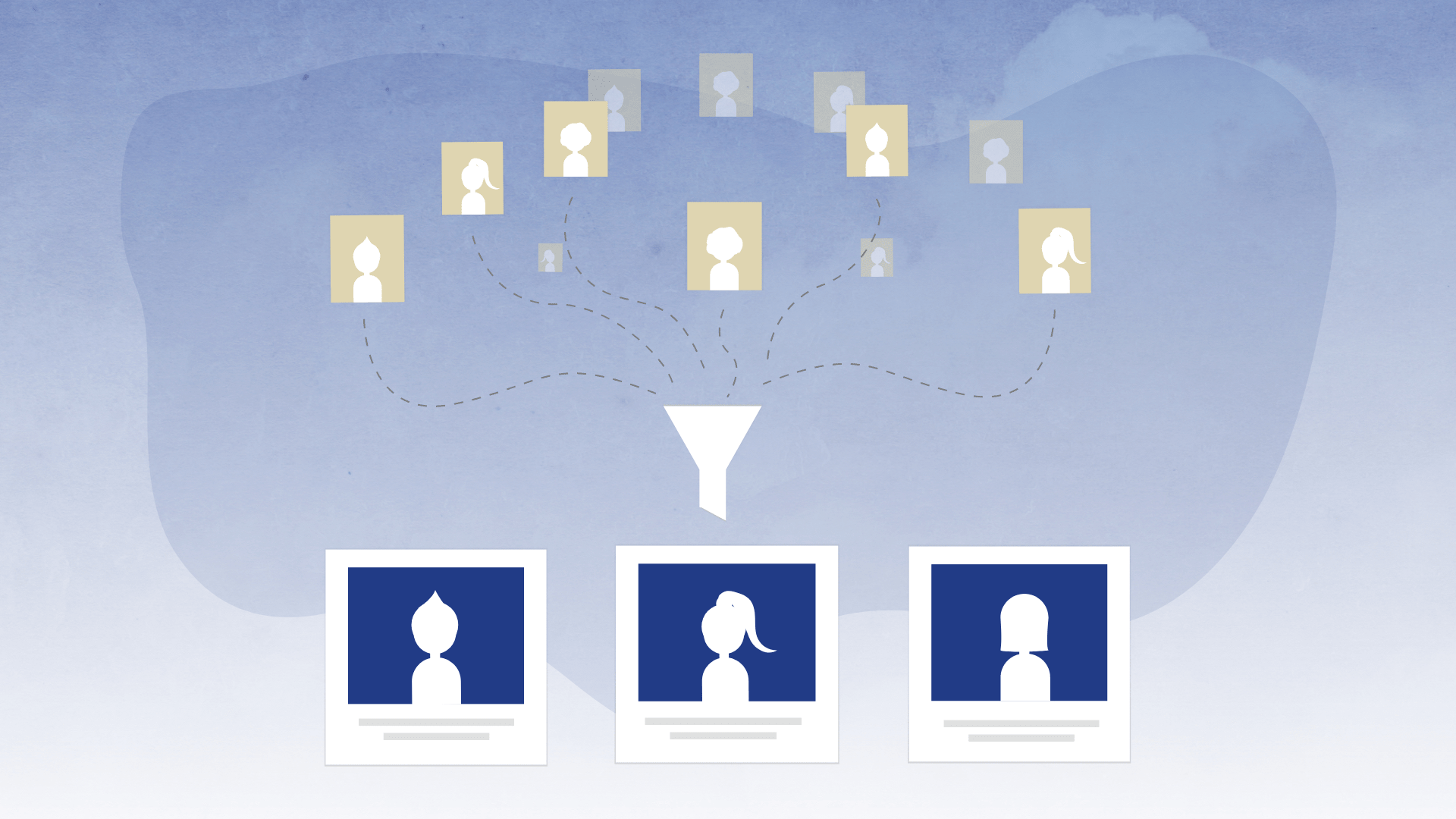
Wait, didn’t we do it in step one? Not exactly. In step one, we defined a target buyer—a generalized set of qualities and behavioral patterns based on previous customers. Here’s how a B2B target audience is different.
Let’s look at this example: Company X sells marketing automation software. Most of their clients have 200 to 1,000 employees and yearly revenues of $10M to $50M. To this point, Company X has relied on network and referral sales, with its CEO taking many of the initial meetings.
When getting ready to launch their first go-to-market outbound the same personas that took initial meetings (referrals from CEOs and CMOs) will be much more difficult to entice. In this instance, Company X may define their target audience as marketing managers, rev ops, marketing titles, and then a separate cadence for the C-suite, including CMOs and CEOs.
A set of characteristics like these define a target audience and, later, will be transformed into the list of keywords for your targeted lead research.
Bonus tip: After you’ve defined a target audience and target personas, you can also make a list of the actual companies you want to target. For instance, if you are looking to target food and beverage manufacturing companies, the most prominent players in the market would be PepsiCo, Tyson Foods, and Nestle.
It probably will be a challenge to grab the attention of these giants; however, targeted lead lists will give you the information and roadmap to build orchestrated, account-based sales development campaigns to start a conversation.
To find the companies that lead in your target market, you can use various lists, such as Fortune 100, 500, or 1000. For the fastest-growing private companies, you can use Inc. 5000 or The Financial Times Fastest-Growing lists as a resource.
4. Search, filter, and collect the data.
When you know who to look for, where do you find your targeted leads? The most popular and fairly effective tool for targeted B2B lead list building is LinkedIn Sales Navigator.
This platform enables effective prospecting for reps. Every advanced lead research in the Sales Navigator starts with keywords and filters. To create a new targeted lead list, researchers create a list of primary search keywords.
Here’s an example of how this works using keywords and filters: Geography (United States, California), Titles (CEO, VP of Technology), Company headcount (51 to 200 workers), Keywords (Marketing Agency). LinkedIn Sales Navigator then filters this data to show your targeted lead result:
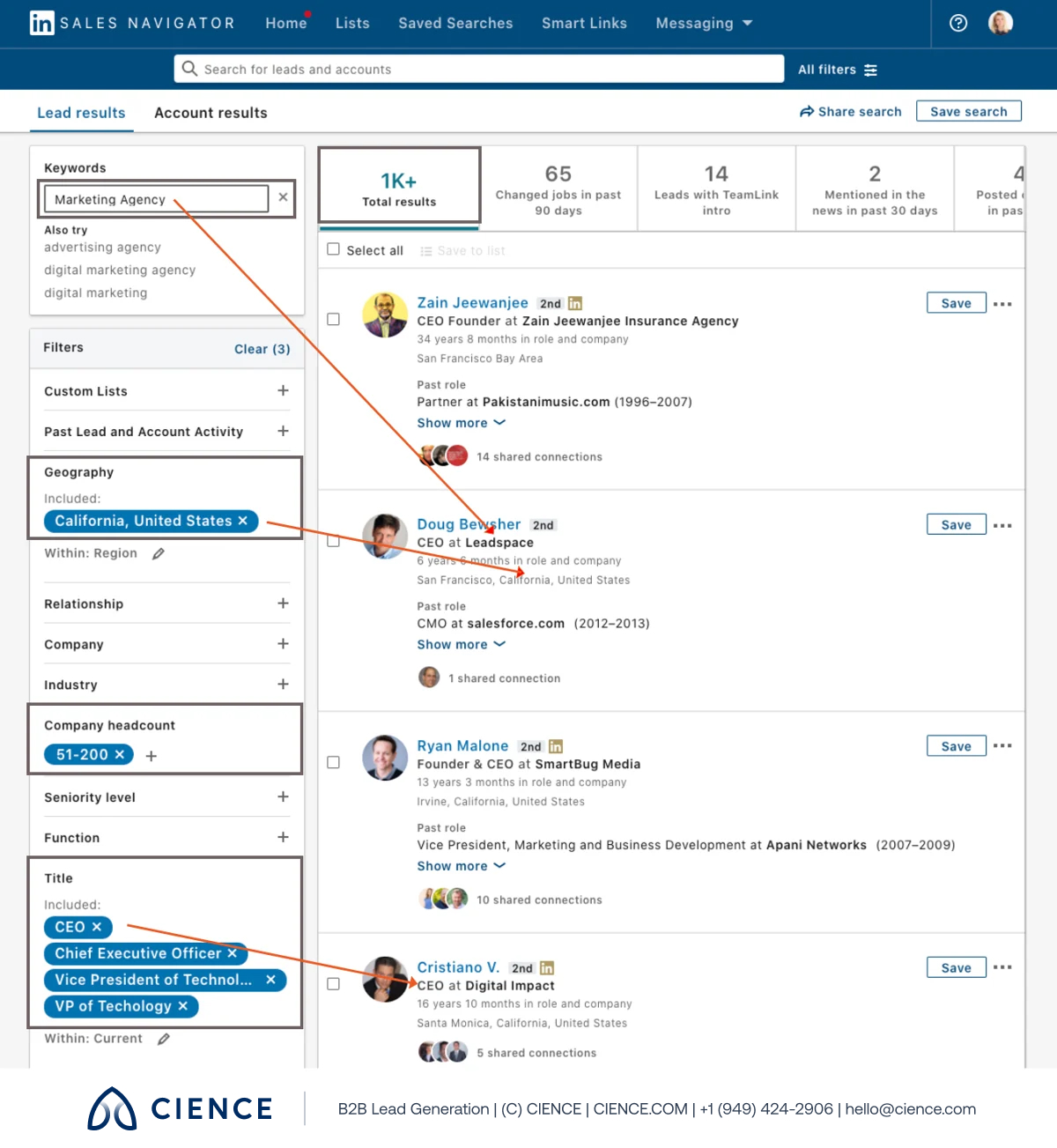
This formula may generate two, six, or ten thousand results. Does it mean that all of these contacts can be transferred to your spreadsheet as leads? Probably not. This is where your researchers earn their keep, filtering the data to curate the best-fit targeted leads. Many opportunities are hidden in advanced firmographic, technographic, or psychographic data.
Here’s another example: Let’s say you are looking for VPs of technology in Northern California. Your company specializes in chatbot technology specialized for B2B conversational marketing.
Now your researchers have to filter those 2,000 results generated by this formula and find those who don’t have any chatbot solution in place and those who have an inferior conversational marketing tool. It is a time-consuming process that requires focus, diligence, and consistency.
There are tools like WebScraper and Data Miner to help scrape certain sites for data, but connecting all these different data sources, and validating the data they spit out, requires a strategic hand.
After data is collected into a spreadsheet, checked and validated, researchers, reps, or SDR managers upload it to a CRM, or sequencer, to serve for outbound campaigns. Now, your targeted lead list is ready for prospecting.
6 Tips for Effective Targeted Lead Generation
Targeted lead generation is an essential part of any successful marketing campaign. Here are six tips to help you create the most comprehensive and accurate lead lists to achieve your business goals:
1. Align software and human resources.
The right software is critical for executing just about any stage of sales and marketing, yet making the data actionable and the systems working together requires human ingenuity.
During lead research, there are data sets that software tools cannot structure— behavioral patterns, meaningful technological stack, recent mergers, etc. Machine-powered, human-driven research is the best way to extract all the seemingly hard-to-find data and get the most detailed lead lists.
In this way, CIENCE GO Data is an invaluable tool for targeted lead generation. It provides access to over 300 million records of real-life validated leads from all industries that match preconfigured ICP criteria so users can quickly and easily build highly targeted lists.
The GO Data package offers a team of sales development specialists to help you create lists according to your specific needs with access to the most up-to-date data. With human-driven data enrichment, you can streamline your sales efforts to create the highest-quality targeted leads.
2. Analyze the data you collect.
Every lead that becomes a prospect and every lead that does not is a source of information for your future marketing campaigns and future optimization of your lead lists. Customer relationship management (CRM) platforms have become staples for maintaining huge, complex contact and customer data. Use it, analyze it, and apply the knowledge for the next targeted lead list building.
3. Always validate the data.
The targeted lead data that you find on LinkedIn profiles may not always be accurate. Make sure to double-check with some additional resources to be sure that a lead can be reached. A contact’s website or ZoomInfo will help you verify company information.
An email verification tool is also needed to validate every email your researchers find. Be careful here as there are hundreds of email verification tools that are not very accurate. Do your research and read reviews to find the best validation tool out there.
4. Keep the quality-to-quantity ratio in check.
Whether you perform research in-house or prefer to outsource, every lead has a price. Quantity doesn’t always mean quality. The cost of a lead includes researchers’ salaries, tech stack, training, and much more. The number of your targeted leads will depend on your resources. The more hard-to-get data you require, the higher the price will be. However, the quality will pay off with a high conversion rate.
5. Enrich existing data.
Inspect the data you already have. Some of it may be incomplete or outdated. To avoid lead waste, update the ones you already have in your CRM. An optimized CRM should make it easier to identify which contacts need attention or if there are duplicates to be removed.
Sales decisions change all the time. Don’t delete old contacts; group them. Some of them may have not been interested while others may have already had a solution in place. However, perhaps a year after, it may be time to ask again.
Implementing and fine-tuning CRMs to scale and sustain growth can be challenging. If you decide to bring in a third-party CRM implementation expert, make sure your outsourced CRM services partner has the certifications to validate their expertise (like being a HubSpot Advanced Implementation Certified partner).
6. Outsource to lead gen experts.
There are many tripwires in building accurate lead lists. A stumble at validation or a lapse at the contact data stage could make any outbound messaging irrelevant. After all, how can you deliver the perfect message if you’re speaking to the wrong audience?
Targeted lead generation can be resource-intensive, which is why an increasing number of companies are outsourcing their outbound top-of-funnel to both scale and sustain growth.
Firms that specialize in contact data acquisition provide their customers with fixed costs, high quality, and expertise. With the help of lead gen experts, businesses can easily and quickly identify potential customers that are most likely to convert. This helps marketers maximize the results of their campaigns by connecting with the right leads at the right time.
Get Highly Targeted Leads
Building targeted lead lists for B2B sales is a complex but essential process. It involves using the right tools and techniques to identify, analyze, and evaluate potential leads, tailoring the list to the specific needs of the business, and validating the list with accurate data.
By following these tips, businesses can ensure that their lead lists are highly targeted and effective. Ultimately, a well-crafted lead list will help your business generate targeted leads that are more likely to convert, resulting in higher conversions and greater ROI for your business.
Get Accurate Leads, Emails & Phone Numbers.
Simple to set up. Easy to use. Powerful integrations.