
What is Lead Generation? The Complete Sales Lead Generation Process [2026 Guide]
![What is Lead Generation? The Complete Sales Lead Generation Process [2026 Guide]](/blog-images/2025/06/Sales-Lead-Generation-Process-3.jpg)
Last Refreshed: March 2026 with updated statistics and tool information.
Lead generation is the sales engine that ensures you won’t run out of customers. Back in the day, the sales lead generation process was limited to a few tools and techniques to know. Then the surge of the internet and digital media changed sales significantly.
Now, when you type in “sales lead generation” into search, you will find millions of sources on how to generate leads in sales and turn them into customers.
Yet, even today, 61% of marketers still find lead generation their top challenge in business. So how do you go about knocking on doors?
Let’s explore the meaning of lead generation today, look at the different types, strategies, and tips, and go through an eight-stage lead generation process to set your business up for success.
What is a Lead?
A lead is an individual or organization that has shown interest in your product or service. This interest is typically expressed when the person initiates contact by submitting personal information in exchange for an offer, trial, or subscription. Unlike receiving an unsolicited cold call, leads come from individuals who have opened a channel of communication with the business.
Leads are potential customers who have entered the first stage of your sales funnel, indicating that they might eventually make a purchase or become a client.
💡 Learn more about how to generate high-quality B2B sales leads.
Leads can be categorized into different types based on their level of engagement and stage in the sales funnel. Here’s a table that outlines the primary types of leads:
Type of Lead
Description
Marketing Qualified Lead (MQL)
A lead that has engaged with your marketing efforts but is not yet ready to make a purchase. Examples include someone who downloaded an eBook or attended a webinar.
Sales Qualified Lead (SQL)
A lead that has been vetted by the sales team and is deemed ready for direct sales follow-up. These leads have shown a higher level of interest and are more likely to convert into customers.
Product Qualified Lead (PQL)
A lead that has used your product and shown interest in becoming a paying customer. This is common in companies that offer freemium products or free trials.
Service Qualified Lead (SvQL)
A lead that has indicated an interest in your services and is ready to engage with your service offerings. These leads typically come from inquiries or service-specific marketing campaigns.
What Is Lead Generation?
Lead generation is a process of attracting, nurturing, and converting leads (potential customers) into existing customers.
Sales lead generation can happen organically: someone is interested in your services, visits your website, fills out a form, and becomes an inbound lead. But for a business to grow in the current climate, it is not enough to rely on other people to find you. You have to engage in both inbound and outbound to secure the growth of your sales pipeline. That’s what lead generation does.
Before going into the actual steps on how to get new customers, let’s go through the most common questions about lead generation:
What is lead generation in digital marketing?
In digital marketing, lead generation refers to the process of identifying and attracting potential customers online through various digital channels. This includes methods such as email campaigns, online phone calls, social media outreach, and search engine marketing. By focusing on online users who match your ideal customer profile, digital marketing lead generation helps businesses connect with potential customers and drive them towards taking a desired action, such as making a purchase or filling out a contact form.
How does lead generation work?
Your lead generation process depends on the goals you have for your sales and the company overall. You can do lead generation through prospecting, advertising, events, or online content creation. Using every method at your disposal is highly recommended.
To effectively attract and convert potential customers into buyers, businesses employ lead generation tactics that encompass reaching out to a target audience through various channels, including social media, email, SEO, and paid ads. This strategy hinges on creating compelling content that resonates with potential leads, encouraging them to engage with the brand.
Is outbound lead generation dead?
Not even close. Some resources like making those loud claims, and many tend to listen. Why? Because it’s not an easy task to do, and not all are qualified to do it. In fact, the biggest challenges of lead generation include data gathering, prospecting, and lead qualification.
Types of Lead Generation
There are two common types of lead generation: inbound and outbound. Inbound is considered organic and less intrusive by using indirect marketing efforts (advertising, events, referrals, SEO, content creation, etc.).
Outbound, however, is an active method of searching for leads, seeking out potential customers, and conducting detailed work to close a deal. Both types are equally important.
Here’s a comparison table of different types of lead generation methods. This table includes various aspects such as their description, benefits, challenges, and best use cases.
Lead Gen Type
Description
Benefits
Challenges
Best Use Cases
Inbound
Attracting prospects through content marketing, SEO, and social media
High-quality leads, long-term results
Time-consuming, requires consistent content creation
Content-rich websites, blogs, social media platforms
Outbound
Reaching out to potential customers via cold calls, emails, and ads
Immediate results, targeted approach
Can be intrusive, lower response rates
B2B companies, sales-driven organizations
B2B Lead Gen
Strategies tailored for generating leads in the B2B sector
Targeted approach, often higher value leads
Longer sales cycles, requires deep industry knowledge
B2B companies, enterprises, service-based businesses
Email Marketing
Sending targeted emails to prospects
Cost-effective, personalized communication
Risk of being marked as spam, requires good email list
E-commerce, SaaS companies, any business with a mailing list
SMM
Using social media platforms to generate interest and leads
Broad reach, brand awareness
Requires constant engagement, difficult to measure ROI
B2C companies, brand building, community engagement
SEO
Optimizing content to rank higher in search engine results
Organic traffic, long-term benefits
Requires time and expertise, algorithm changes
Blogs, websites with significant content
Content Marketing
Creating valuable content to attract and convert prospects
Builds trust, educates audience
Time-consuming, requires quality content
Blogs, whitepapers, eBooks, video content
PPC Ads
Paying for ads that appear on search engines and other platforms
Immediate visibility, highly targeted
Can be expensive, requires continuous management
E-commerce, lead generation for specific campaigns
Affiliate Marketing
Partnering with other businesses to promote products/services
Performance-based, extends reach
Requires good partnerships, potential for fraud
E-commerce, online services, B2C businesses
Webinars & Online Events
Hosting live online presentations or events
Engages directly with audience, showcases expertise
Requires planning and promotion, technical issues
B2B companies, educational content, product demos
Referral Marketing
Encouraging existing customers to refer new ones
High-quality leads, trust factor
Hard to scale, dependent on customer satisfaction
Service-based businesses, SaaS, high customer loyalty
Networking & Events
Attending or hosting events to meet potential clients
Builds relationships, face-to-face interaction
Time-consuming, may not be scalable
B2B companies, local businesses, professional services
Partnerships & Alliances
Collaborating with other businesses for mutual benefit
Expands reach, shared resources
Requires strong relationships, potential for conflict
Technology companies, service providers, consultancies
Influencer Marketing
Using influencers to promote products/services
Access to niche audiences, builds credibility
Can be costly, choosing the right influencer
B2C companies, lifestyle brands, fashion, and beauty
The Importance of Lead Generation
Simply put, lead generation equals business growth. It ensures you never run out of customers, keeps your income stable, and continuously brings in new opportunities.
But it’s more than just sales. Lead generation raises brand awareness(19%), builds natural customer loyalty and relationships, and creates organic interest around your company’s name. According to HubSpot, 61% of marketers say generating traffic and leads is their top challenge, yet those who excel in lead generation see 7.5 times more conversions.
Additionally, companies that focus on lead nurturing can generate 50% more sales-ready leads at 33% lower cost, highlighting the importance of a comprehensive lead generation strategy. This multifaceted approach not only boosts sales but also enhances overall brand presence and customer engagement.
8-Stage Lead Generation Process
Every lead, no matter where it comes from, goes through a certain journey to become your client: awareness, attraction, outreach, conversion, and close.
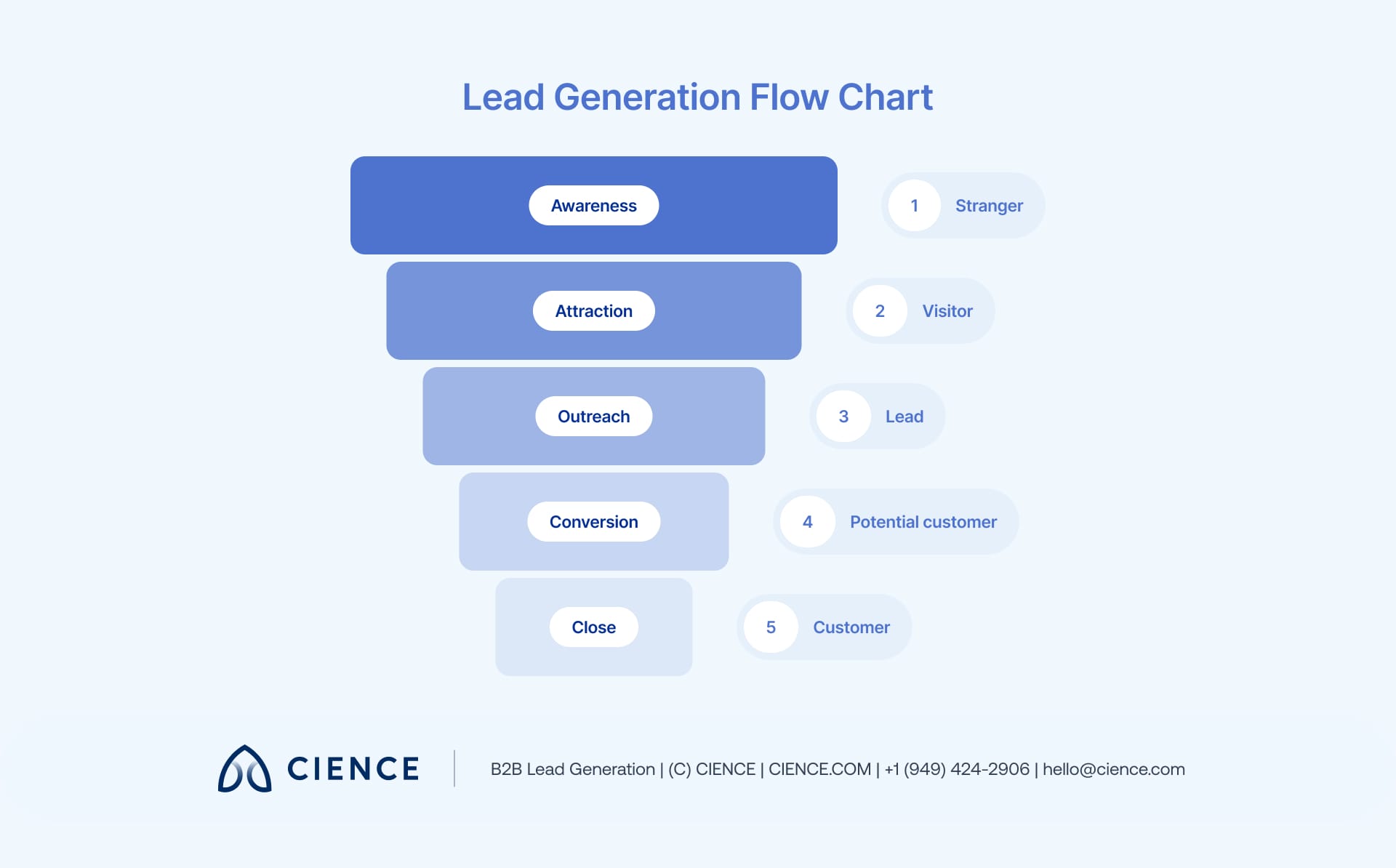
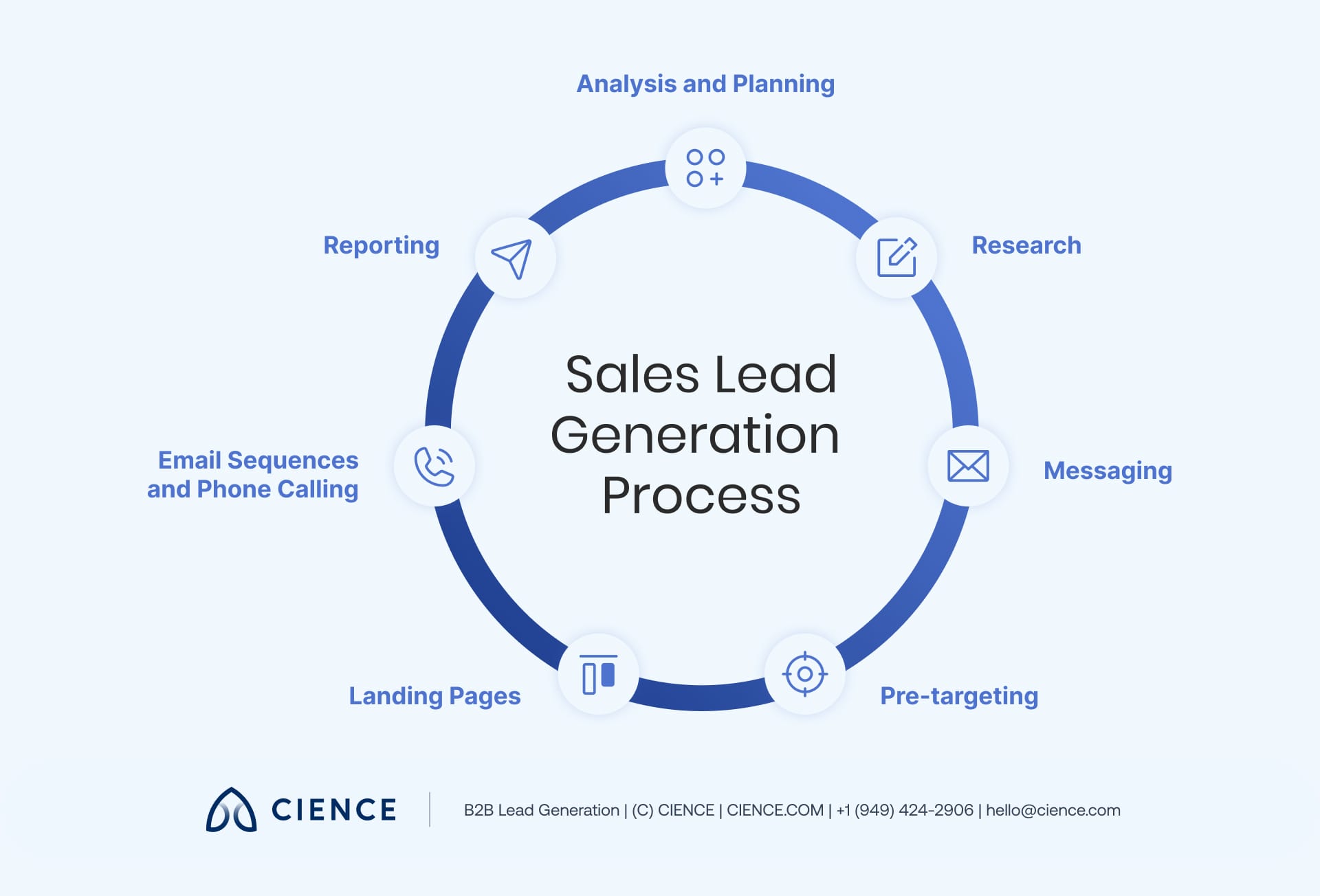
Each stage consists of multiple steps needed to qualify and nurture potential customers through the sales funnel. To ensure desired results, follow these eight stages in the sales lead generation process: analysis and planning, research, messaging, pre-targeting, landing pages, email sequences and phone calls, reporting, and new planning.
Stage 1. Analysis and planning
Any good business project begins with a plan. Start by defining your goals, outlining your budget, researching, and targeting your ideal clients using these seven steps:
- Access the human resources needed.
Your team must include a specific number of people for each position—you’ll need at least one full-time researcher, a sales development representative (SDR), and an email copywriter. While businesses have traditionally relied on human copywriters, advancements in technology have introduced AI email writers to the market. An SDR can handle multiple accounts if necessary. Additionally, you’ll want a VP of marketing (or manager) to align sales and marketing efforts to make the most out of the lead generation process.
- Analyze and outline the budget.
To decide on the starting budget for your outbound prospecting team, you should analyze the average salary on the market (browse the wages of your competitors and colleagues in the field) and include every possible expense that you may have along the way:
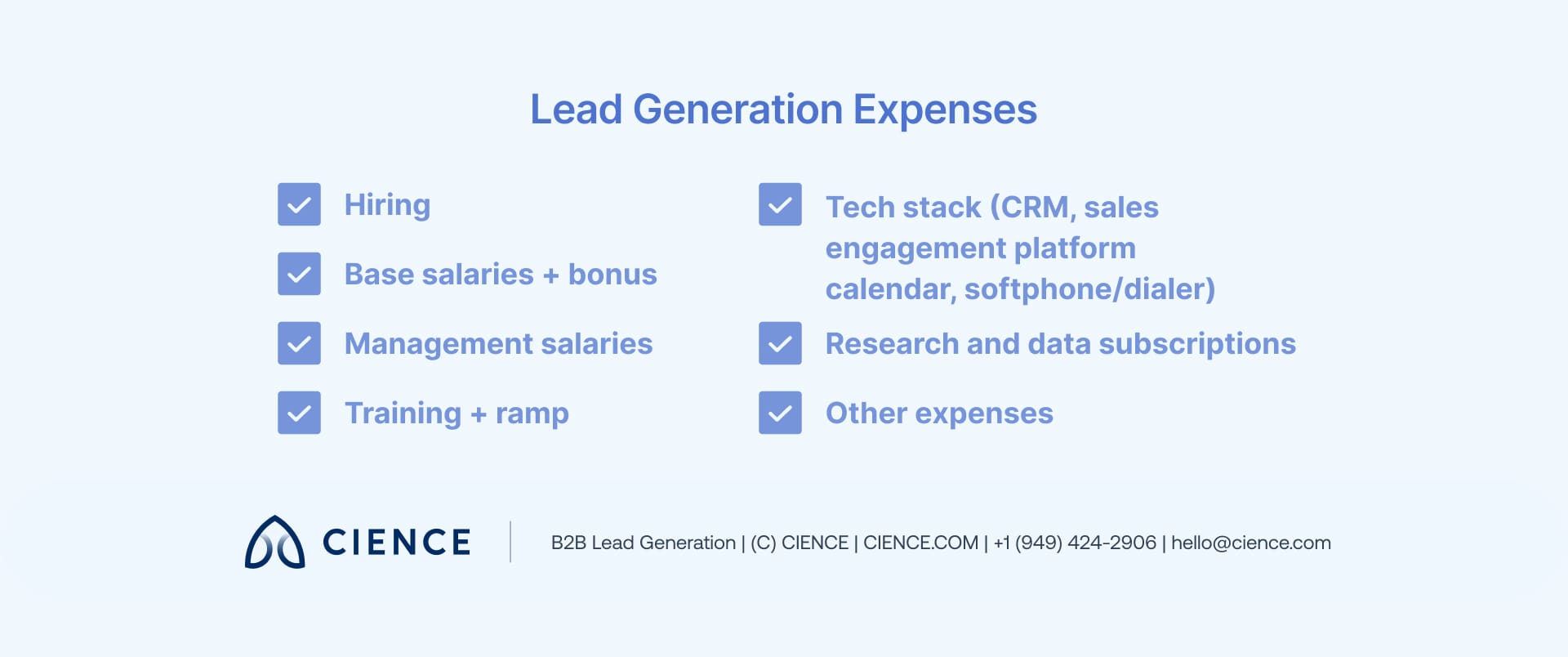
In addition to the direct expenses, it’s also important to understand the underlying costs involved in generating each lead. The cost per lead, often overlooked, is a critical factor in the overall budget planning for any sales development team. To gain a detailed understanding of these costs and how they can affect your budget planning, consider this comprehensive breakdown of the cost per lead.
- Research the market and competitors.
Start with creating an ideal customer profile (ICP). This ideal profile sets features based on your previous customers’ analysis and your sales pipeline. It includes demographic, firmographic, and technographic characteristics that define your ideal customer.
Ask these questions as you research: Who are your main competitors? What are their strengths and weaknesses? What is their reputation management strategy? And most importantly, why is your solution better?
💡 Learn more about how to build your perfect ICP
- Analyze potential clients.
While an ICP is your map for finding leads, a buyer persona is used for targeting them. It includes generalized psychological traits, social habits, buyer behavior, and the professional experience of your potential customers.
The buyer persona helps you to understand what moves your lead toward a purchase, whether it is a desire, ambition, or a pain point they face. You’re not just selling for the sake of selling; you are trying to address their problems and offer a solution.
A buyer persona is essential at every stage of the lead generation process in sales. Make sure to update it and create new ones based on different criteria (various types of products, the size of a company, or an industry). Make it brief, easy to understand, and as precise as possible.
- Set the timing.
Figure out the deadlines for your lead generation campaign. Set the launch date along with the timeline for your campaign. Make sure to figure out the daily to-dos for your team members (SDRs, researchers, copywriters, etc.).
Decide on the frequency and cadence of your email campaigns. Always take into account the time necessary for your SDRs to ramp up.
- Choose the tools.
A customer relationship management (CRM) tool is vital for the lead generation process. If you don’t have one, you should consider investing in this software. If you have a CRM, re-examine it—perhaps it’s time to migrate or it’s costing you too much.
You’ll next need to define which lead generation software is the one that you’ll use apart from a trusted CRM tool. It can be used for prospecting, lead list building, sales intelligence, data enrichment, or social media outreach.
The advent of a new era in AI development has brought significant automation to the lead generation and sales development process. Therefore, investing in AI sales development tools is essential if you want to scale your efforts and not fall behind your competitors.
💡 Find out the top AI lead generation tools
- Plan, plan, plan.
In this step, you’ll want to define the goals of your lead generation process. What will your SDRs be responsible for? Qualifying leads, appointments, or both?
Be sure to set the weekly or monthly quotas for your sales reps. These benchmarks should control, motivate, and, most importantly, be realistic to achieve.
Outsource All-in-One Lead Gen Solutions
Stage 2. Research
Providing up-to-date accurate data will set the tone for your lead generation. To achieve high-quality results, follow these steps in the research process:
- Prepare.
Before you begin, your researchers should be trained in the following areas:
- How to build and analyze ICPs and buyer personas
- Where to look for leads
- How to filter out bad data
- How to work in the database
💡 Explore the top 20 places to buy leads
- Research.
The process for researchers involves looking for leads and contact information with data provider tools, uploading the data to a CRM, and handing off the database to SDRs who can immediately start to prospect.
- Report.
Reporting is essential to monitor each worker’s performance and keep track of incoming leads. You should set a cadence for reporting—daily, weekly, or monthly. Most of the prospecting tools offer reporting and filters to create targeted analytics and interactive digital reports.
Get Targeted Leads Now!
Stage 3. Messaging
Messaging in the lead generation process can be used in various channels: emails, landing pages, cold calling scripts, social media posts, pre-targeting ads, and playbooks.
Your messaging should answer the following questions for a potential customer:
- Why me?
- Why this product/service?
- Why now?
The content should target the buyer persona, be short, simple, and most importantly, human. Use personalization to make your messaging feel more authentic. Take about five to fifteen minutes to research each lead and then up to thirty minutes to craft your message. Finish your copy with a solid call to action (CTA) with a link to your landing page.
Stage 4. Pre-targeting
Not all leads are ready to be prospected right away. Some of them need warming up to avoid wasting the SDR’s time and lead’s temper. To get the most out of outreach, you’ll need pre-targeting ads. These help put your sales lead generation process into motion by:
- Raising brand awareness
- Warming up leads for your cold outreach
- Boosting your outbound marketing KPIs (click-through, conversion, and response rate)
Pre-targeting enables your company to show its ads to users who have never visited your website but are looking for the solutions you provide. It’s an effective method to target potential customers early in their buyer’s journey.
Stage 5. Landing pages
A landing page is a website page with a specific goal—to facilitate the desired action, such as setting a discovery call or gathering contact information in the lead generation process.
So why should you use landing pages instead of links to your website? A website contains a whole lot of useful information and various CTAs while the landing page focuses on a specific action and eliminates other distractions. It allows you to segment the audience into micro-groups and send out highly targeted messages.
Follow these tips to create a good landing page for your target audience:
1. Add a catchy headline.
To keep users from leaving your site, you only have a few seconds to grab their attention. The value that your service provides should be the first thing they see.
For instance, the CIENCE landing page with the headline “B2B Contact Database with over 200 Million Contacts” gained an average 2.5% conversion rate and a bonus of 5 appointments per month.
2. Create a custom CTA.
A landing page’s copy must thoroughly support your CTA and lead a user toward taking the desired action. The tone should be compelling, direct, and straightforward.
Base your CTA on the goal of your lead generation efforts. Keep it short and instructive: “Make an appointment,” “Fill out a form,” or “Contact our experts.” Include the CTA button above the page’s fold, meaning no scrolling is needed. You can add one more at the bottom of the page.
3. Use a responsive and relevant design.
A good design is vital for landing pages. It must be:
- Relevant: Always stick to the topic of your services.
- Clickable: Links and forms must work correctly.
- Optimized for mobile devices: Mobile-optimized websites get 15% more unique clicks.
When crafting landing pages, make sure to secure your website with the right hosting solution so your content is secure and reliable when it reaches your customers.

Stage 6. Email sequences and phone calling
Lead generation stages are not set in stone: You can change the order a bit, exclude or add something. However, if you are going all in, you have to prioritize email and phone outreach. Those are two of the most important prospecting channels that are easy to track and optimize results. Follow these steps in your approach:
- Check, research, and upload.
Once the leads are handed over to the SDRs, you should do another data check. This way, no matter how many leads are going into your pipeline, the chances of an unverified data record slipping through the cracks will be zero.
Once the templates for email and calling scripts are completed, the leads can be uploaded into the CRM to begin outreach.
- Send, handle, and follow up.
Before sending any messages, group your contacts by time zones. This way, your first sales pitch arrives at the best time possible. Use your CRM to set the time and day of delivery for any group of leads.
Now, wait for the responses. As they come in, your SDRs should handle them quickly to move your lead through the sales funnel. To deal with incoming replies, create a script with answers to common questions to move the process along. If you don’t receive an answer, follow up in a timely manner (24 to 72 hours is recommended).
- Prioritize, call, and qualify.
Cold calling is a very effective lead-generation method, especially when combined with cold emailing. After the first send-out, a CRM will show whether the email was opened, how many times, and if the links inside were clicked or not. This information gives your SDR an idea of who to call first. A lead that shows more activity should be on the call priority list compared to the ones that haven’t opened the email at all.
Now, it’s time to call. It’s the ultimate sales moment here—an SDR will get a chance to qualify the lead and set an appointment if all goes well. To ease the calling process, always provide a cold calling script for your SDRs. It will help with training and prepare them for the call.
A qualified lead is one that is ready to move down the sales funnel (from being a lead to becoming a prospect). To qualify a lead, you should choose one of the various lead qualification methods.
💡 Choose your right lead qualification method: BANT vs NOTE
When both email and call outreach is done, SDRs must fill in the stats for future reporting. Every lead response must be recorded in a spreadsheet of CRM and used later to track and adjust campaign performance.
However, not every sales lead generation process includes cold calling. Some businesses prefer email outreach only. It depends on the industry’s specifics, and that’s why marketing research is vital during analysis and planning.
Try Our Experienced Appointment Setters
Stage 7. Reporting
Reporting is present at almost every stage of the lead generation process: This includes tracking how many leads were entered in the CRM, how many calls were successful, and how many introductory meetings went exactly as planned.
By the end of the lead generation campaign, you’ll want to gather every KPI you’ve ever tracked and compile it into one extensive report. You can do this through special reporting tools like building a KPI dashboard or creating a template yourself.
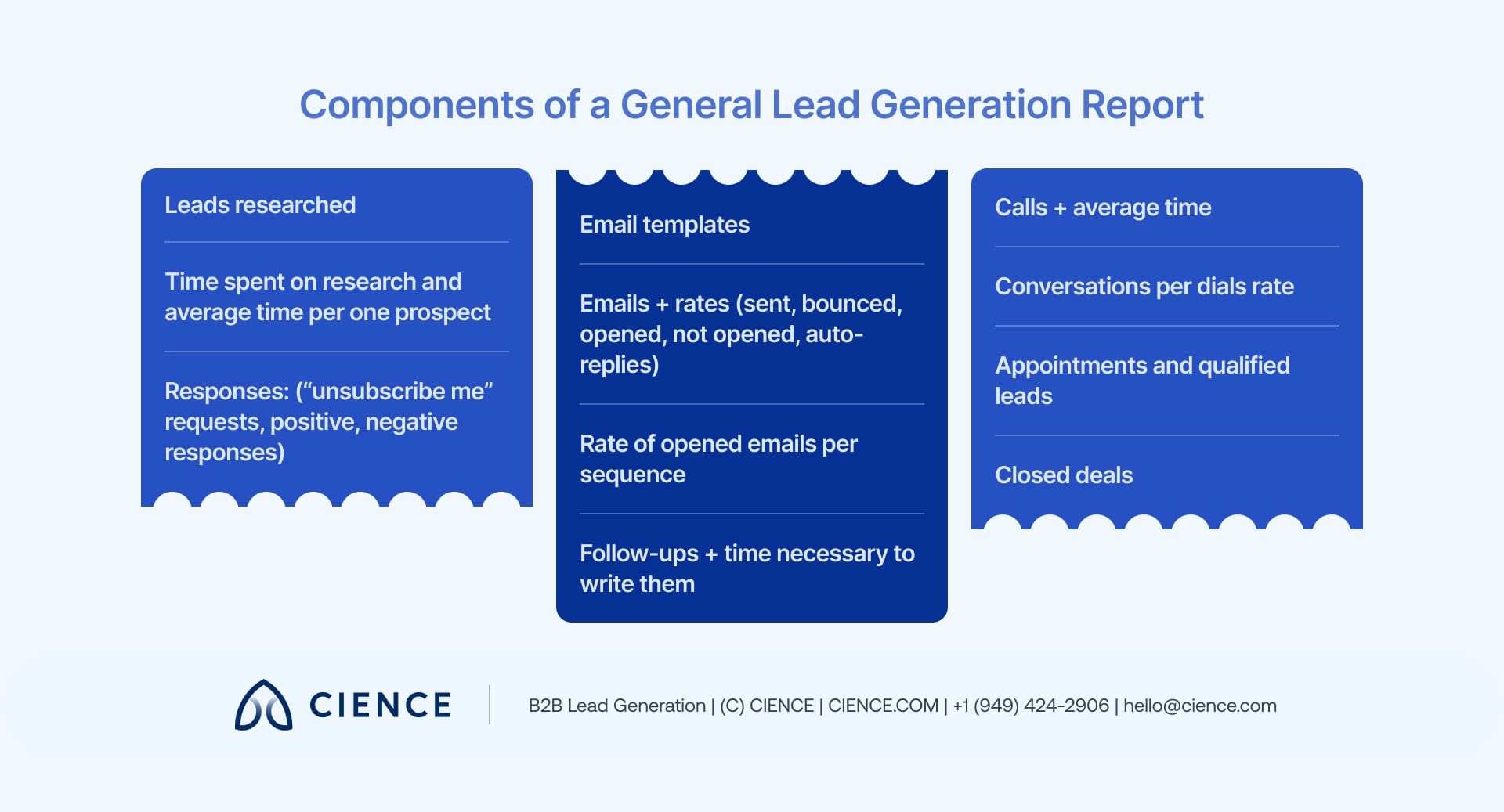
Once you have the report, you’ll see what’s working or not, where leads may have gone cold, or what needs to be adjusted for better results. Spend some time analyzing it along with the reports from the marketing side (content production, social media, and advertising) to get a full picture of your lead generation process.
Note that sometimes sales cycles are longer, so you may need to initiate reporting stage before any deals close.
Stage 8. New planning
The lead generation process is the most effective when it’s ongoing. Once you think you’re at the end of one campaign, you should already prepare for the next one. To see the best results, you have to continuously look for new leads, start new campaigns, and hopefully learn from your past mistakes.
Being able to evolve is vital in a competitive business environment, so once you analyze KPIs and goals, make adjustments for the next round of lead generation. Were your templates convincing and warm enough? Do your sales reps need more call training? Are any of your tools outdated?
Answer all of those questions, highlight the areas of improvement, and start again, only this time better.
Proven Lead Generation Tips to Boost Your Business
Implementing effective lead generation strategies can significantly impact your business growth. Here are some proven tips along with relevant statistics to help you maximize your lead generation efforts:
1. Leverage Data and Analytics
Use advanced data analytics to identify high-quality leads. Analyze customer behavior, demographics, and engagement patterns to refine your targeting and improve lead quality.
Why: Data-driven insights can help you identify the most promising leads and tailor your approach to their specific needs. Companies that use data-driven marketing are six times more likely to be profitable year-over-year.
2. Utilize Lead Generation Tools and Services
Use specialized lead generation tools and services to streamline your process. Tools like CIENCE, Salesforce, HubSpot, and LinkedIn Sales Navigator can help automate tasks, manage leads, and provide insights.
Why: Leveraging these tools can improve efficiency, increase the accuracy of your lead generation efforts, and free up time to focus on high-value activities.
Try Your Best Lead Gen Solution
3. Personalize Outreach Efforts
Personalize your communication with potential leads. Use their name, reference their company, and address specific pain points in your emails, calls, and other outreach efforts.
Why: Personalization can significantly increase response rates and build a stronger connection with leads.
4. Use Account-Based Marketing (ABM)
Implement an ABM strategy to target high-value accounts with personalized marketing campaigns. Focus on specific companies that fit your ideal customer profile.
Why: ABM allows for more efficient resource allocation and better targeting of high-value leads. 87% of B2B marketers report that ABM delivers higher ROI than other marketing activities.
5. Use Lead Magnets
Provide potential clients with a free lead assessment or audit. This demonstrates your expertise and gives them a taste of the value you can provide.
Why: Free assessments can help build trust and show prospects the potential ROI of your services. Offering free value can increase conversions by up to 33%.
6. Leverage Case Studies and Testimonials
Tip: Showcase case studies and testimonials from satisfied clients to demonstrate the effectiveness of your lead generation services.
Why: Social proof helps build credibility and trust with potential clients.
7. Focus on Multi-Channel Outreach
Utilize a combination of email, phone calls, social media, and direct mail to reach potential leads through multiple touchpoints.
Why: Multi-channel outreach can increase the chances of reaching and engaging leads. Multi-channel campaigns achieve 24% higher conversion rates than single-channel campaigns.
8. Implement Lead Scoring
Use lead scoring to prioritize leads based on their likelihood to convert. Assign scores based on factors such as engagement level, company size, and fit with your ideal customer profile.
Why: Lead scoring helps focus efforts on the most promising leads, improving conversion rates.
9. Optimize Your Website for Conversions
Your website is often the first point of contact for potential leads. Ensure it is user-friendly, loads quickly, and has clear calls-to-action (CTAs).
Why: According to HubSpot, companies with 30 or more landing pages generate 7 times more leads than those with fewer than 10 landing pages.
10. Leverage Content Marketing & SEO
High-quality content attracts and engages potential leads. Create valuable blog posts, eBooks, whitepapers, and videos that address your target audience’s pain points.
Why: Content marketing generates 3 times as many leads as traditional outbound marketing but costs 62% less. Companies that prioritize SEO are 13 times more likely to achieve a positive ROI compared to those that don’t.
11. Utilize Social Media
Social media platforms are powerful tools for lead generation. Share engaging content, interact with your audience, and use paid ads to reach a broader audience.
Why: Studies show that 77% of B2B marketers use social media to generate leads.
12. Invest in Email Marketing
Email marketing remains one of the most effective lead generation channels. Segment your email list and personalize your messages to increase engagement.
Why: Email marketing has an average ROI of 4,400%, making it a crucial strategy for lead generation.
13. Nurture Your Leads with Automated Workflows
Develop a lead nurturing strategy to build relationships with potential customers over time. Use marketing automation to create lead nurturing workflows that keep potential clients engaged over time. Send targeted content based on their stage in the buyer’s journey.
Why: Nurtured leads make 47% larger purchases than non-nurtured leads.
💡 Explore more lead generation strategies in 2024
Boost Your Sales Lead Generation
A solid lead generation process is fundamental to developing long-term business and revenue growth. It may seem overly complicated at first glance, but what new process isn’t?
You have to invest in teams, tech stacks, content creators, and marketing because all of these are part of a big and powerful sales engine. And no matter what industry you come from or what services you offer, having lead generation strategies in place will do one thing for sure—generate high-quality customers.