
B2B lead management is the process of capturing, tracking, qualifying, distributing, and nurturing leads until they purchase. The average B2B conversion rate from lead to sale is 2-11%, and 47% of buyers purchase from sellers who understand their needs. Use CRM tools, multichannel outreach, and data hygiene to maximize conversions.
Last Refreshed: March 2026 with updated statistics and tool information.
B2B lead management is the systematic process of capturing, tracking, qualifying, distributing, and nurturing potential customers until they convert into paying buyers. For companies well-grounded in B2B today, lead management goes far beyond routing leads acquired through marketing campaigns.
From Daniel Conn, GTM Strategist, graph8: “Most companies treat lead management as a volume problem — more leads, more tools, more noise. The ones that win treat it as a data quality problem. A well-managed list of 500 qualified, enriched prospects consistently outperforms an unmanaged list of 5,000.”
When considering the average lead conversion rate, managing leads the right way is essential for generating meaningful revenue. In B2B, the average conversion rate from lead to sale ranges between 2% and 11%, depending on your target market and execution. CIENCE has worked with 2,500+ clients across 250+ industries — and a 4.6/5 rating on Capterra — because consistent results come from disciplined lead management, not just more outreach.
You’re on the right track if you’re focused on improving conversion. The most common issue is that companies either aren’t managing leads with sufficient rigor, or they’re not generating enough high-quality leads to begin with.
This guide walks you through everything you need to understand about B2B lead management and how it applies to your company’s growth.
What Is Lead Management?
Lead management is the process of acquiring, organizing, and managing potential customers until they purchase your product. Think of it as a structured way of engaging your target audience until they’re ready to buy.
Because of the attention to detail this process requires, lead management is more technical than advertising or other direct marketing channels.
In simple terms, B2B lead management starts with getting potential customers from various sources, then distributing them to sales teams who carry out follow-up through offline and online engagement.
Lead activities are monitored via ad clicks, email opens, website visits, and real-time meetings.
Lead management is critical for building customer relationships at an individual level. It helps companies understand customers and speak to their pain points to provide lasting solutions.
Fun fact: Over 47% of customers buy from a seller who understands what they need — which makes lead management not just operational infrastructure, but a direct driver of revenue.
B2B Leads vs. B2B Customers
B2B leads are people who have expressed interest in your product or service. B2B customers are people who have purchased.
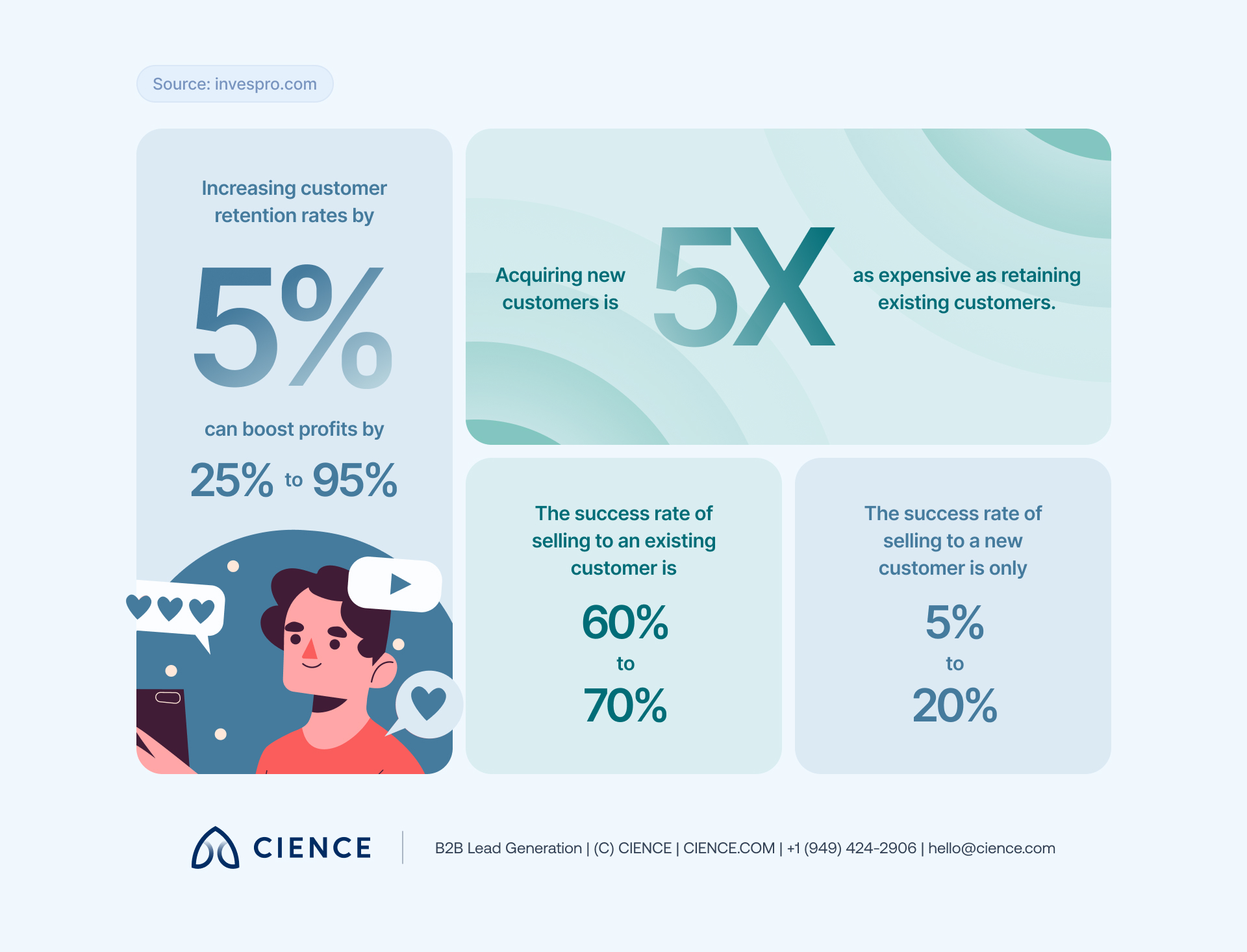
According to Invesp, the sales probability from leads is 5–20%, while the probability from existing customers is 60–70%. This gap shows why lead management — the bridge between lead and customer — matters so much.
Turning prospects into customers is far more demanding than retaining them. It can cost five times more to acquire a new customer than to keep one. Increasing customer retention rates by just 5% can boost profits by an estimated 25–95%.
Strategies of acquisition
Acquiring leads relies on brand campaigns, advertising, and content marketing. Acquiring customers happens through outbound marketing, inbound marketing, demos, discounts, and trials.
Nurturing strategies
B2B lead nurturing builds trust with prospects and engages them enough to move forward with conviction. Customer nurturing focuses on product updates, new features, testimonials, and renewal offers.
Revenue-generating potential
Lead revenue potential is realized through sales conversions. Customer revenue is generated via cross-selling, subscription renewals, and upsell.

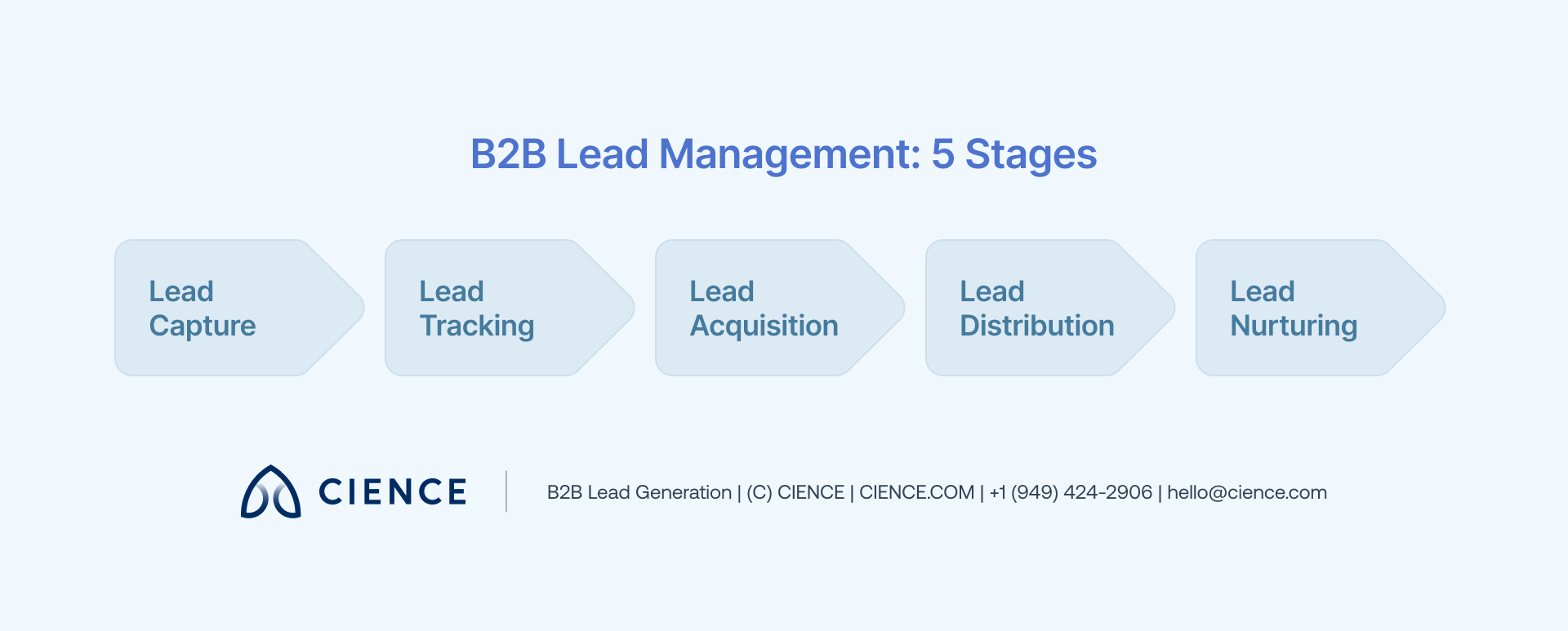
The Lead Management Process: 5 Stages
Acquiring leads is one thing. Taking them through a process that yields the desired result is another. Here are the five stages of B2B lead management.
1. Lead capturing
The foundational step of lead management is lead capturing. You run marketing campaigns that signal your company’s value to prospects, pulling as many relevant leads as possible into a reliable customer data platform.
Critical data — email addresses, phone numbers, company information — must be collected reliably at this stage.
2. Lead tracking
Collecting contact data isn’t enough. Lead tracking lets you monitor prospect behavior so you can assess sales readiness. Key activities to track:
- Page visits. When prospects visit specific pages — pricing, about us, product pages — it signals buying intent. A follow-up team should respond to this behavior promptly.
- Email engagement. Track open and reply rates using CRM tools and B2B data services to identify which prospects are worth prioritizing.
3. Lead qualification
Lead qualification is where many companies lose deals. According to Spotio, about 67% of sales losses trace back to poor qualification.
Leads are qualified based on interest level and capacity to buy. The goal is to evaluate how well your product matches the prospect’s needs — asking the right qualification questions and recording everything for future reference.
4. Lead distribution
Lead distribution requires sorting leads carefully before assigning them to sales teams. Each lead should be routed based on product interest, industry, or geography.
The goal: the right lead reaches the right rep with full context, so every team member is current on where the prospect stands.
5. Lead nurturing
Lead nurturing transforms qualified prospects into buyers. Lead nurturing generates direct revenue from prospects who are now fully aware of your product and confident enough to act.
Benefits of B2B Lead Management
Without a well-crafted lead management workflow, you risk losing a large share of your pipeline. Here are the core benefits:
1. Management of opportunities
When leads are well managed — with timely follow-up and full context — companies convert a higher percentage and lose fewer opportunities to silence, slow response, or misrouting.
2. Proper lead data management
B2B prospect data (behavior and identity) must be maintained for future reference. Well-managed leads can be mapped to sales activity and used to build an accurate picture of pipeline health.
3. Helps follow up on your sales funnel
Lead management lets you visualize your B2B sales pipeline and marketing performance. When you can track pipeline metrics, you can take strategic action to improve conversion at each stage.
If your cost-per-meeting keeps climbing despite adding tools and reps, the problem isn’t execution — it’s the model.
“CIENCE built us a scalable, predictable pipeline — we generated over 4,000 leads in the first four months.” — August Ash

Lead Management Best Practices
A Forbes study found that most companies struggle to update their lead generation and management strategies. Here are five proven practices:
1. Use proper tracking.
Proper tracking in B2B lead management helps your company monitor leads and record their progress through the buyer’s journey. Use pipeline metrics — open rates, reply rates, click-through rates, and unsubscribe rates — to stay current on what’s working.
2. Create internal management processes.
When all customer-facing teams — sales, marketing, and support — understand the lead management process, your company presents a coherent experience to prospects. Without internal alignment, different reps pitch different angles to the same prospect at the wrong time.
3. Utilize multiple channels in your marketing campaign.
Don’t rely on a single channel. Outbound lead generation strategies and multichannel outreach — including PPC advertising, webinars, email marketing, and cold calling — give you more data on what works and more touchpoints with prospects.
4. Measure the right metrics.
Basic pipeline counts aren’t enough. All metrics must be well-defined and traceable to dynamic, up-to-date data. Without this, you can’t optimize resources or identify conversion bottlenecks. Use high-quality B2B data to feed your measurement systems.
5. Capture feedback with surveys.
When leads arrive from multiple directions, you may not know which product they’re interested in. Surveys — deployed through tools like Salesforce or HubSpot — help you understand prospect needs and segment your follow-up accordingly. Feedback also improves your overall qualification criteria over time.
Build Lead Management Strategies for Success
By now, you understand the B2B lead management process and its advantages for converting leads into paying customers. The process starts with lead capture and ends with meticulous nurturing — and every stage depends on data quality, process discipline, and team alignment.
CIENCE and graph8 have helped 2,500+ companies build these systems, rated 4.6/5 on Capterra across 250+ industries. Whether you’re starting from scratch or fixing a broken pipeline, the path forward starts with understanding where leads are being lost.
Improve Lead Management With CIENCE →
“60% of our early sales were directly tied to leads CIENCE generated. They were effectively our sales engine in the first year.” — Armatic
CIENCE + graph8 pricing: $5,000 one-time GTM system setup, $2,499/mo strategic execution, and the graph8 platform at $499/mo. No long-term contracts. See full pricing →
Whether or not you decide to work with us, you’ll walk away with a clear picture of where your pipeline is leaking and what it would take to fix it.
Frequently Asked Questions
What is the difference between lead management and lead generation?
Lead generation is the process of attracting and capturing new leads through marketing campaigns, ads, and content. Lead management is what happens after — organizing, qualifying, distributing, and nurturing those leads through the sales pipeline until they convert into customers.
How do you measure lead management success?
Track key metrics like lead-to-customer conversion rate (B2B average is 2–11%), lead response time, cost per lead, and pipeline velocity. Companies that respond to inbound leads within 5 minutes are 100x more likely to convert them than those responding after 30 minutes.
What tools are essential for B2B lead management?
A CRM platform (like HubSpot or Salesforce) is the foundation, paired with a customer data platform for lead enrichment, email verification tools to prevent data decay, and marketing automation software for nurturing sequences. Integrating these tools into a single system improves visibility across teams.

A graph8 company — AI-powered GTM execution across 250+ B2B industries.
graph8 Platform
From $499/mo
Run your own GTM campaigns with AI-powered data, sequences, and analytics.
Start Free — 2,500 Credits No credit card requiredCIENCE Managed
From $2,499/mo
Our GTM teams build and run your outbound campaigns end-to-end.
15-min call · No commitment2,500+ B2B companies served · Month-to-month contracts · See full pricing →