
AI transforms B2B marketing across 8 proven areas — from automated lead scoring that identifies high-intent buyers to hyper-personalization at scale. With 66% of B2B buyers expecting companies to fully understand their needs, AI lets teams deliver tailored experiences across every channel without adding headcount.
Last Refreshed: March 2026 with updated statistics and tool information.
Artificial intelligence transforms B2B marketing across 8 critical areas — from automated lead scoring and hyper-personalized content to SEO optimization and 24/7 chatbot-powered customer service — enabling marketers to deliver the tailored experiences that 66% of buyers now expect. AI complements human intelligence rather than replacing it, making every marketing touchpoint smarter and more efficient.
From Thomas Cornelius, Founder & CEO, graph8: “Most B2B teams use AI to speed up what they’re already doing — faster emails, bigger lists. The real leverage is the signal AI surfaces: which accounts are showing buying intent right now, which contacts just changed roles, which competitors your prospects are actively evaluating. That’s the difference between AI as a tool and AI as a GTM system.”
Artificial intelligence (AI) is enriching the B2B marketing landscape with dynamic capabilities. Marketers can use AI technologies like machine learning and algorithms to automate their marketing processes and inject increased intelligence into their marketing strategies. As a result, B2B marketers can optimize and personalize their customer experiences.
For some, the term “artificial intelligence” conjures up dystopian, Hollywood-fueled images of evil robots destroying the human race. For others, it evokes a quieter (but no less terrifying) vision of robots replacing humans in the workplace. However, as more and more businesses embrace AI, it’s becoming universally clear that rather than replace human intelligence, AI serves to complement it.
As integrity and hyper-personalization permeate customer expectations, marketers in every industry are leveraging AI to create better customer experiences. Here are eight ways that AI is transforming B2B marketing.
1. Improves Lead Generation and Scoring
Generating high-quality leads, followed by generating a high number of leads, are the two biggest challenges faced by marketers today.
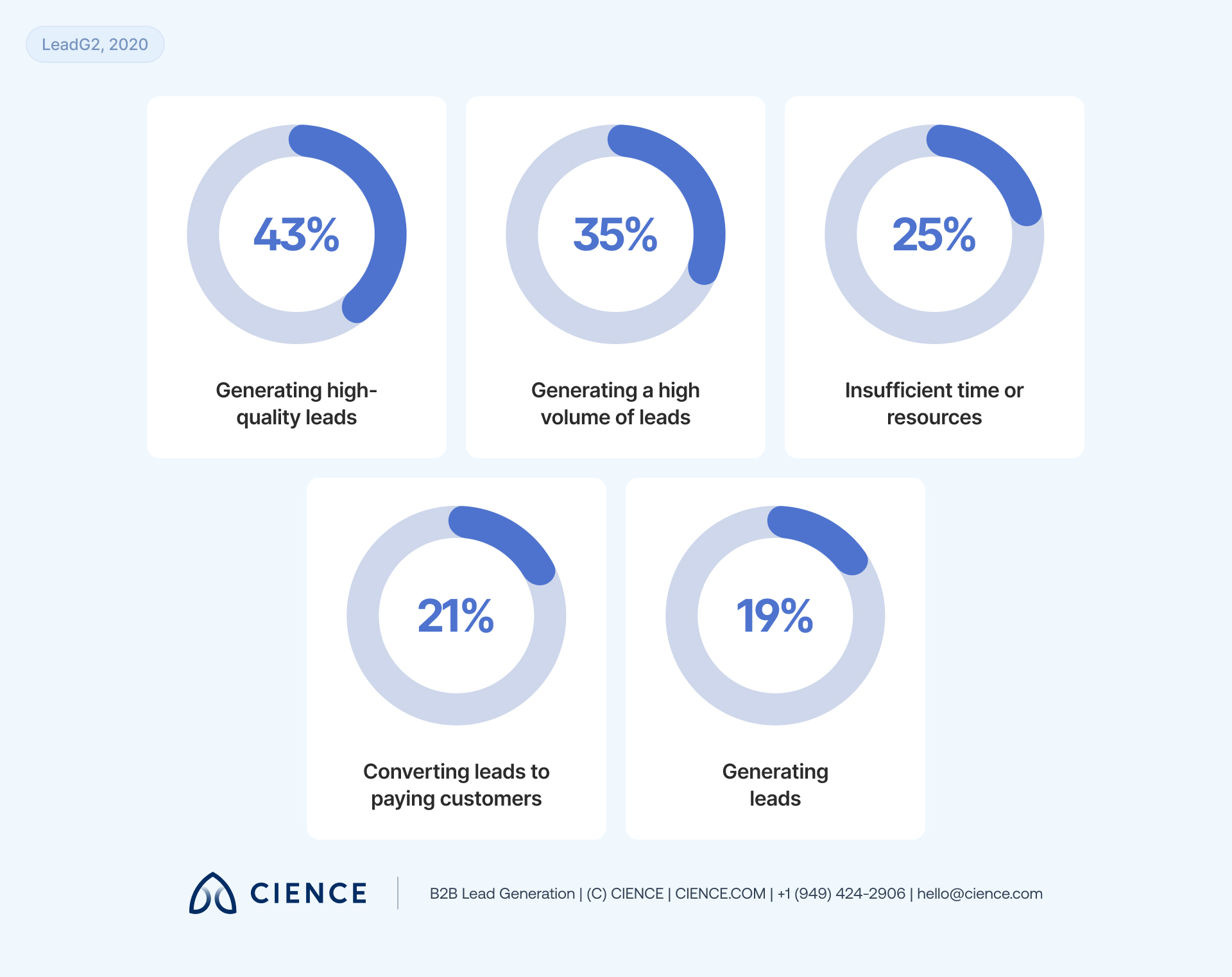
Part of the problem lies in the labor intensity of data collection, management, and analysis. To solve this issue, data collection and analysis can be automated by integrating AI into lead generation processes. This, in turn, will increase the quantity and quality of generated leads.
AI can dig deep into sales funnels to capture hyper-accurate, real-time dynamic data across channels and databases that may be inaccessible to, or overlooked by, human marketers. Armed with this improved visibility and data accuracy, marketers can identify more leads, create nuanced target personas, and implement lead scoring systems that are more comprehensive.
CIENCE works with 2,500+ clients across 250+ industries — rated 4.6/5 on Capterra — and the teams seeing the highest ROI are the ones using AI to qualify leads before they ever reach a human. AI allows marketers to spend less time manually collecting data and more time using that data to drive pipeline.
2. Creates Better Customer Insights
For businesses aiming to execute personalized targeting from the second a customer enters the sales funnel, creating accurate buyer personas and ideal customer profiles (ICP) is critical.
Combined with AI, social listening and analysis tools can help businesses achieve these goals. For example, you might gain insight into your customers’ pain points, buying behaviors, or who your competitors are targeting. All of this can be used to strengthen buyer personas and create customized environments.
With accurate buyer personas and ICPs, businesses are positioned to approach potential and existing customers with the right content at the right time. This targeting precision is exactly what powers the B2B data layer behind high-performing outbound programs — matching the right message to the right account before the first touchpoint.
3. Enhances Customer Experiences
At a consumer level, smart technology is where AI truly shines. Digital assistants like Alexa and Siri paved the way for voice-based technology. Now, consumers aren’t just using voice searches to merely browse the internet — they’re buying things, too.
AI digital assistants are continuously learning, growing more intuitive to their users’ speech patterns and browsing habits to tailor search results to their users’ preferences. Businesses are taking advantage of this by optimizing their website for voice searches.
When your cost per lead keeps climbing but pipeline stays flat, adding another tool won’t fix it. You need a different system.
“CIENCE helped us reach 150 qualified companies with a 10% conversion rate — results we couldn’t have achieved with our internal team alone.” — Turn Technologies
Not only does this put their website in front of more potential customers, but it also plays into inclusive website design strategies that make websites more accessible to everyone.
4. Personalizes B2B Marketing
If you’re worried that using AI might dehumanize your brand’s content marketing strategy, then worry no more. AI is actually a personalization power tool that you should be using to your advantage.
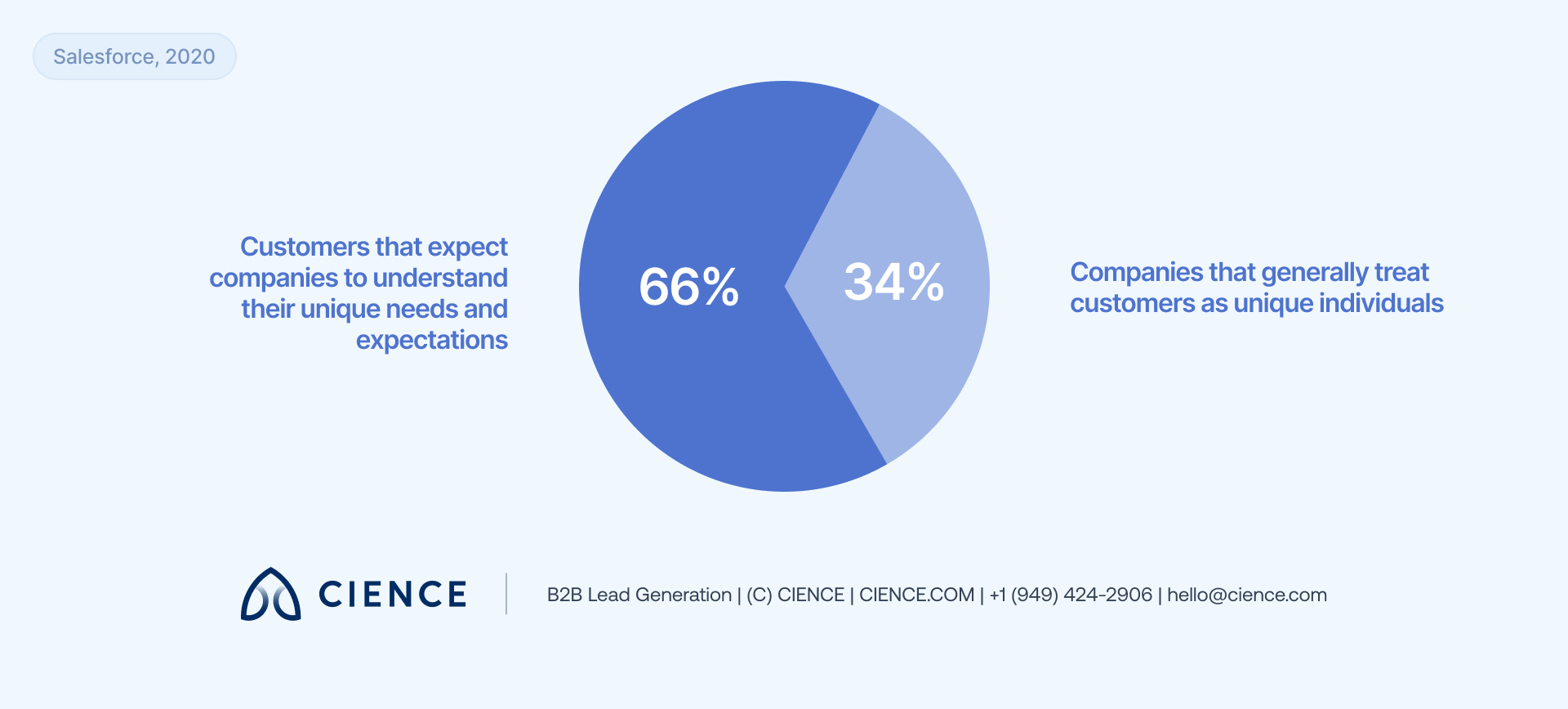
Customers want businesses to understand their unique needs and preferences, and they’re prepared to boycott a brand entirely if it doesn’t meet their expectations. This means that general pitches are unanimously redundant, but personalization at scale is hard work.
According to Salesforce’s State of the Connected Customer report, the vast majority (66%) of customers expect companies to fully understand their unique needs and expectations.
AI-driven marketing simplifies the process by helping businesses gather buyer behavior insights and create accurate buyer personas. This information can be used to curate hyper-targeted marketing material like landing pages, blog content, cold email sequences, digital advertisements, and more.
From there, B2B marketers have the power to initiate timely, personalized conversations with customers, appealing to their pain points and anticipating their desires. Even better, with AI these conversations can be scaled through marketing automation without proportionally scaling headcount.
5. Optimizes Website and App Performance
How often do you scrutinize your website’s performance data to identify issues or areas for improvement?
Website analytics can be so convoluted that interpreting them strategically on a consistent basis is a grueling task. AI-powered tools (like Google Analytics Intelligence) use machine intelligence to condense complex data into easily digestible and actionable insights.
One of the best things about AI in this respect is that marketers can be immediately notified of any sudden or undesirable data shifts. If there was a sudden spike in a critical metric like a website’s bounce rate — the percentage of people who leave after a single-page session — AI tools would send real-time alerts alongside any other relevant data.
These spikes can point to business-damaging technical errors, so this is a metric you want to keep a close eye on.
The same considerations should be made for mobile apps, too. Widely considered to be the leading future platform for B2B marketing, 65% of B2B companies have a mobile app in response to rising B2B mobile usage.
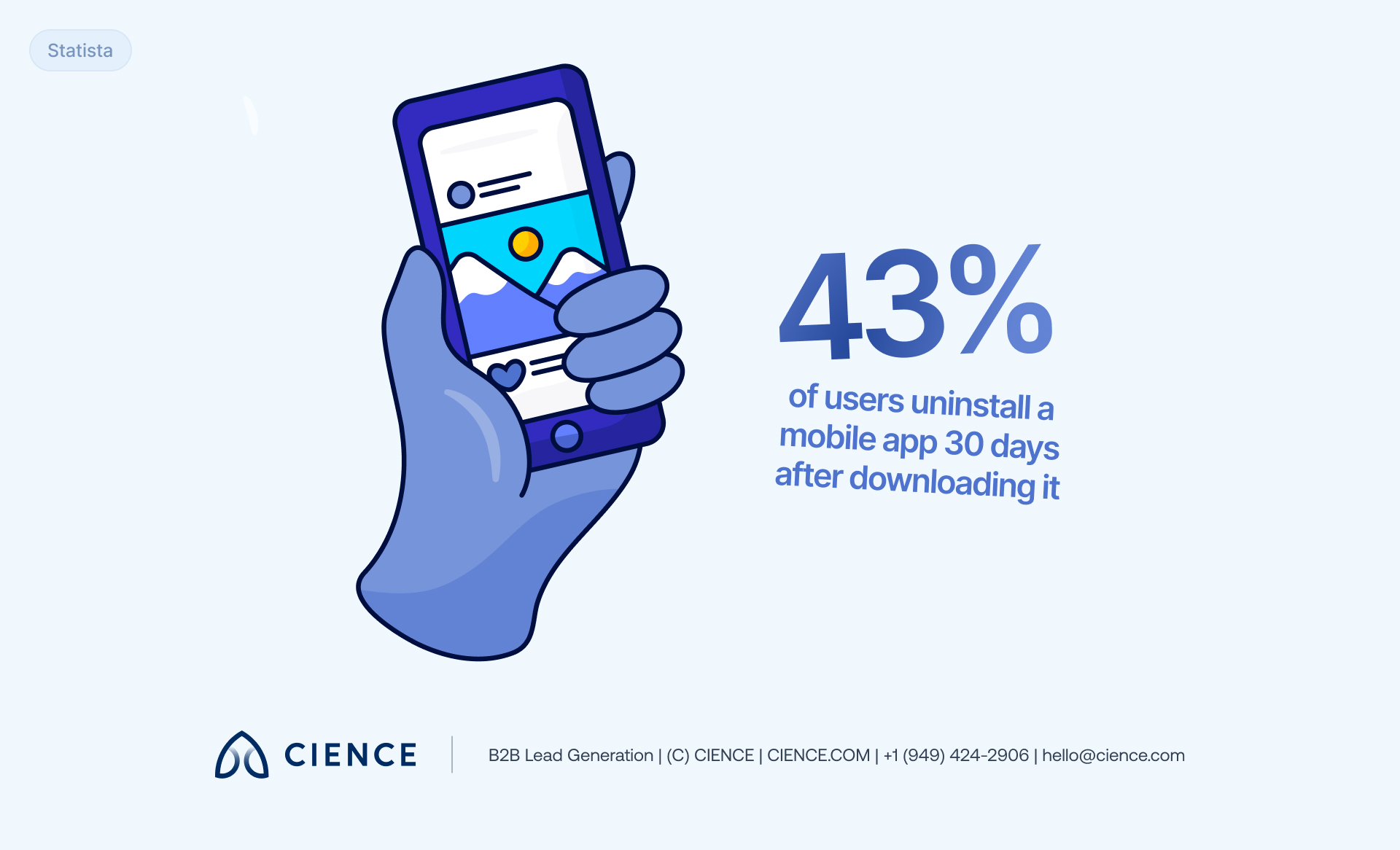
However, whether due to lack of value or a poor UX, mobile apps are also deleted at an alarmingly high rate. According to Statista, 43% of users uninstall a mobile app within 30 days of downloading it.
Just like website analytics, app analytics alert marketers to potential issues, ensuring they can rectify problems before they damage pipeline or user trust.
6. Simplifies SEO
AI-powered SEO tools do more than simply save you time by sourcing relevant keywords. They can heavily inform new content by identifying trending topics, making keyword predictions, and uncovering competitive gaps for forward-thinking targeting. They can also optimize old content for SERP by performing dynamic keyword and linking updates — keeping your existing content fresh and your new content ahead of the curve.
When it comes to actually crafting content, AI can’t quite master the nuances of emotive, engaging copywriting. However, there are a number of AI-powered sales intelligence tools that writers and marketers can use to enhance their work. Grammarly, for instance, combines grammar rules with machine learning, deep learning, and natural language processing to help teams produce professional, error-free content at scale.
The ad management side benefits too — AI optimizes bidding, audience segmentation, and creative testing in real time, reducing wasted spend on low-intent targets.
7. Increases Customer Engagement
Publishing timing is one of the most overlooked levers in B2B content marketing. Even well-optimized content underperforms if it reaches inboxes and feeds at the wrong moment. This is where AI steps in, driving maximum customer engagement by ensuring that content reaches audiences at exactly the right time.
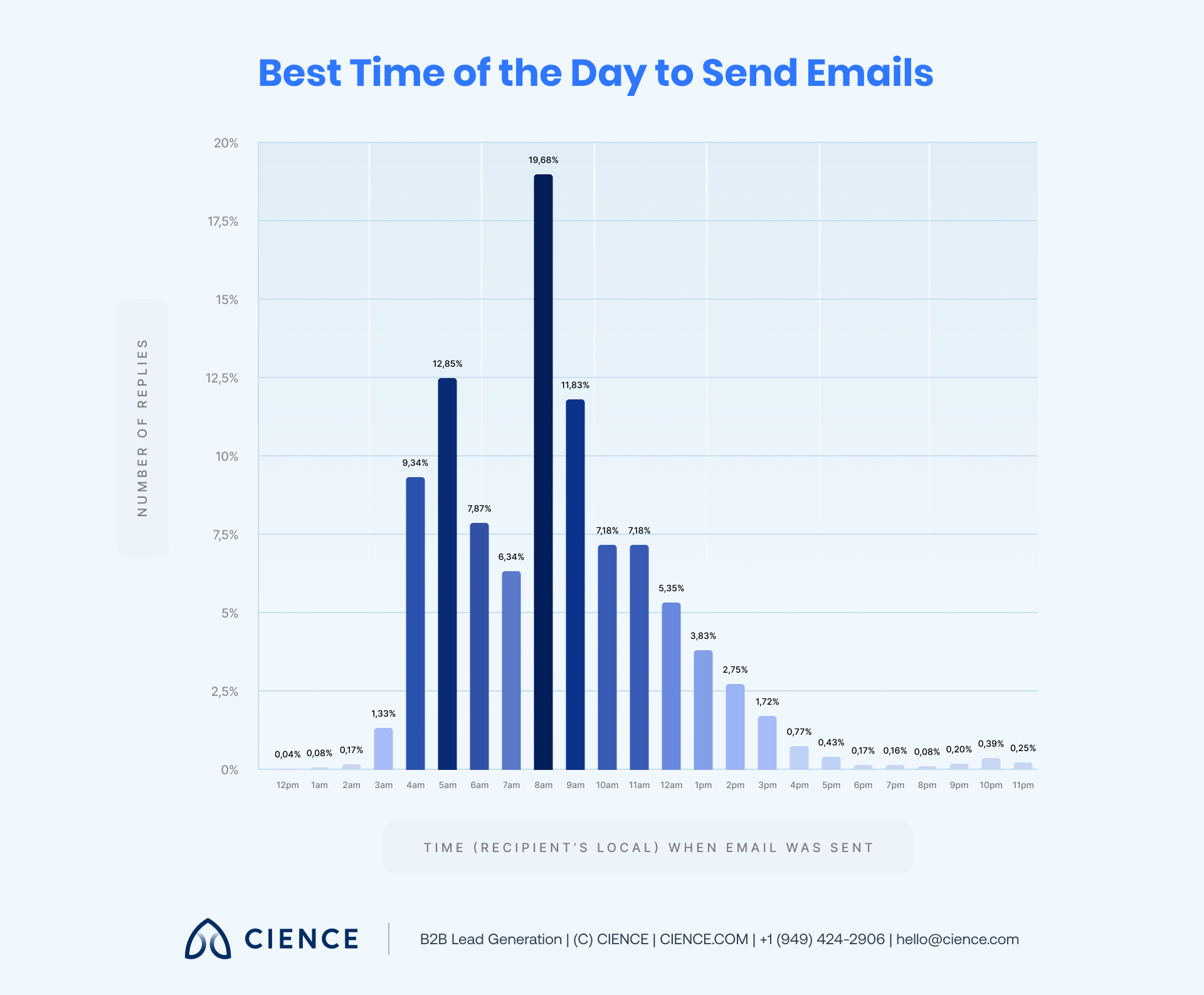
As a baseline, the best time to publish a blog and social media content is in the afternoon/evening. The best time to send marketing emails is in the morning. AI monitors a business’s unique website data and customer behaviors to pinpoint optimal publishing times to the minute.
AI-powered scheduling tools can automatically publish content, inadvertently increasing globalization potential.
Time isn’t the only thing that marketers need to consider when publishing content. The platform they publish to and the devices they optimize for are also important factors. Rather than relying on guesswork, AI analysis tools discover exactly which platforms and devices targeted customers are using.
8. Improves Customer Service and Customer Relationships
Nurturing positive customer relationships through high-quality customer service is a number one priority. But how do you provide personalized, omnichannel customer service to hundreds of accounts within your sales funnel simultaneously?
Customer service automation is the leading use of AI for businesses today. AI applications like chatbots and interactive voice response (IVR) systems exist at both pre-and post-sale customer service touchpoints, capable of performing transactional requests, order tracking, account updates, and much more.
By letting AI handle the simpler tasks, agents are free to focus on customer inquiries and services that require problem-solving and empathy. These customers receive more attentive service, which goes a long way in nurturing positive customer experiences.
There’s another reason why 39% of B2B companies want self-service options. AI applications allow businesses to deliver quick and convenient 24/7 customer service across multiple channels. This has established AI implementation as one of the fundamental best practices for companies with enterprise ambitions.
How to Put AI to Work in Your B2B Marketing
Artificial intelligence isn’t just changing the marketing space — it’s restructuring the business world as we know it. Marketing remains one of AI’s strongest use cases, with its impact felt not just by businesses but customers too. By providing businesses with the tools and insights to deliver value at every touchpoint, B2B customers can enjoy better brand relationships and more relevant experiences.
The eight areas above aren’t isolated — they compound. Teams using AI for demand generation and lead scoring see better results from their personalization efforts because the data is cleaner and the targeting is sharper.
“We tripled our weekly meetings booked after partnering with CIENCE — the pipeline impact was immediate and measurable.” — Mandolin
CIENCE + graph8 pricing: $5,000 one-time GTM system setup, $2,499/mo strategic execution, and the graph8 platform at $499/mo. No long-term contracts. See full pricing →
Whether or not you decide to work with us, you’ll walk away with a clear picture of where your pipeline is leaking and what it would take to fix it.
Frequently Asked Questions
Will AI replace human B2B marketers?
No. AI serves to complement human intelligence, not replace it. AI excels at data collection, pattern recognition, lead scoring, and automating repetitive tasks — freeing marketers to focus on strategy, creative storytelling, and relationship building. The most effective B2B marketing teams use AI to handle scale while humans provide empathy, judgment, and nuanced decision-making.
What is the best AI application for B2B lead generation?
AI-powered lead scoring is the highest-impact application for most B2B teams. AI can analyze vast data sets across channels and databases to identify high-intent prospects, create nuanced buyer personas, and score leads with far greater accuracy than manual methods. This automation reduces the time marketers spend on data collection and lets them focus on converting the best-fit leads.
How does AI improve B2B customer personalization at scale?
AI gathers behavioral data, purchase history, and engagement signals to build accurate buyer personas, then uses those insights to generate hyper-targeted content across email, ads, landing pages, and chat. According to Salesforce, 66% of B2B customers expect companies to understand their unique needs. AI-powered marketing automation delivers that personalization across hundreds of accounts simultaneously — something impossible to do manually.

A graph8 company — AI-powered GTM execution across 250+ B2B industries.
graph8 Platform
From $499/mo
Run your own GTM campaigns with AI-powered data, sequences, and analytics.
Start Free — 2,500 Credits No credit card requiredCIENCE Managed
From $2,499/mo
Our GTM teams build and run your outbound campaigns end-to-end.
15-min call · No commitment2,500+ B2B companies served · Month-to-month contracts · See full pricing →